
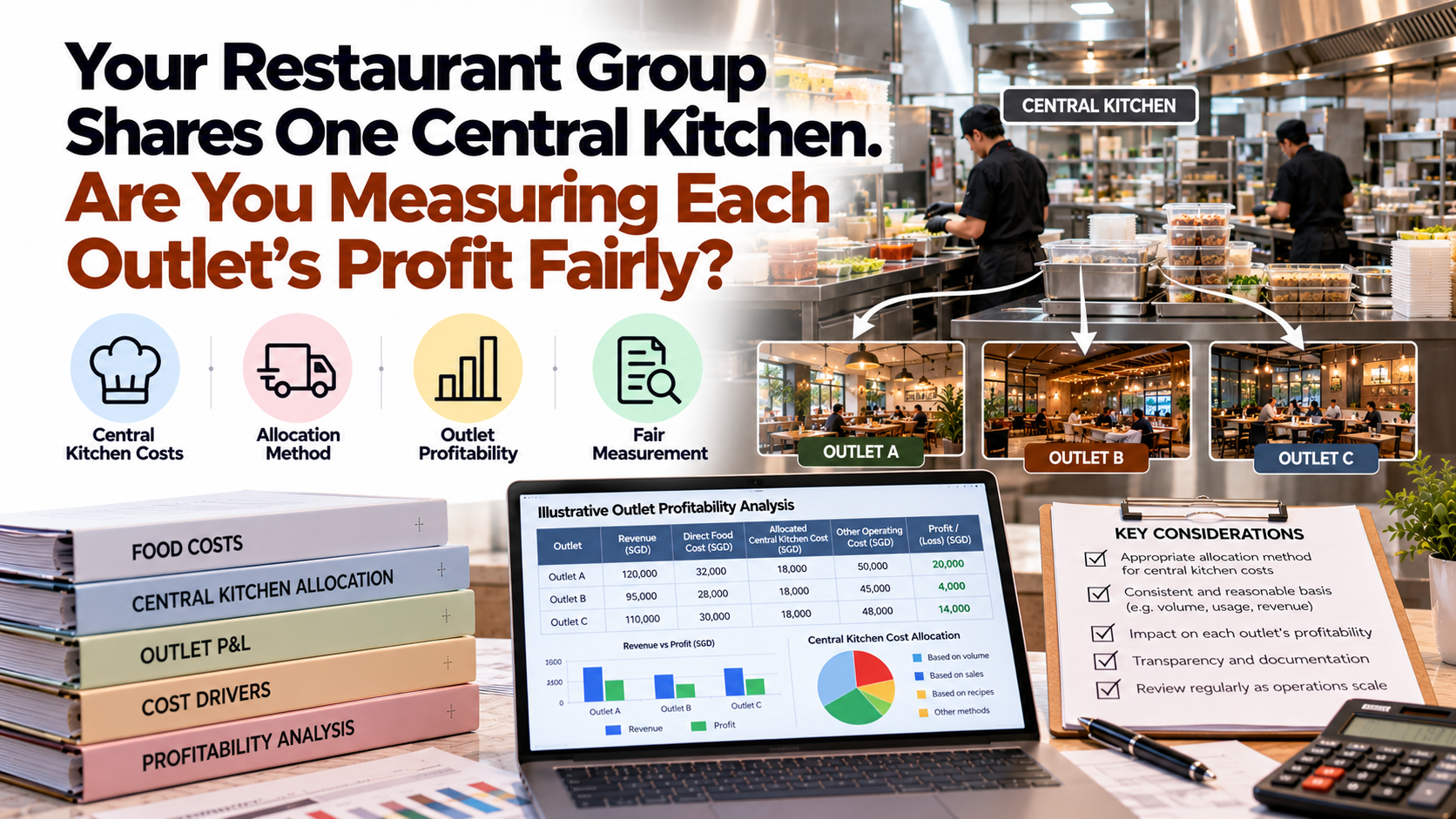
A central kitchen can help a restaurant group prepare ingredients consistently, consolidate purchasing and reduce duplicated work across outlets. As the network expands, one production team may supply sauces, baked goods and prepared components to several locations each day.
Yet the monthly profit reports can tell a confusing story. A busy outlet appears to earn very little after its central kitchen charge, while a smaller location looks unusually profitable. Outlet managers question the figures, and head office struggles to explain whether the differences reflect operating performance or the way shared costs were divided.
Credon provides accounting and financial reporting support for businesses seeking a clearer understanding of their performance. For a restaurant group, that clarity starts with connecting costs to how the kitchen and outlets actually operate. A consistent allocation can help management compare locations, but consistency alone does not make the method meaningful.
The objective is to understand what each outlet contributes, which resources it uses and where improvements would benefit the group.
When One Kitchen Serves Different Operating Models
Outlets within the same group may have very different requirements. A takeaway location might receive large batches of a limited menu, while a full-service restaurant orders smaller quantities of more complex items. Another outlet may require several deliveries because storage space is limited.
Those differences affect the central kitchen’s workload. Preparation time, packaging, chilled storage and delivery activity may not rise in the same proportion as outlet sales.
An equal split of kitchen costs is easy to calculate, but it can ignore those differences. Allocating everything by revenue can create another distortion: an outlet with higher selling prices may receive a larger charge even when it consumes fewer kitchen resources.
Before changing the calculation, map what the central kitchen does for each location. The financial model should reflect the service being provided, rather than simply use whichever number is easiest to retrieve.
Begin With Reliable Records of Food Movements
A useful outlet report needs a dependable record of what was supplied. If kitchen dispatches and outlet receipts are incomplete, a more sophisticated allocation formula will not resolve the underlying problem.
Use consistent product references and units. A tray, kilogram and portion should not be treated as interchangeable without a documented conversion. Where the kitchen supplies a sauce in bulk, establish how that quantity connects to the recipe or serving assumptions used in costing.
Record returns, transfers and rejected deliveries as well. An outlet may send surplus items to another location, and the cost should not remain assigned to the original outlet without explanation.
Credon’s bookkeeping and accounting services include maintaining organised financial records. For a restaurant group, the corresponding operational discipline is essential: finance needs accurate information from production and outlet teams to turn transactions into useful management reports.
Trace What Can Be Identified Directly
Start with costs that can reasonably be traced to a product, batch or outlet. Ingredient quantities, dedicated packaging and special orders may be identifiable without allocating a broad monthly total.
Standard recipes can provide a starting point for ingredient costs, but they should be checked against actual purchasing prices and production yields. A recipe based on an outdated price or unrealistic output can understate the cost of everything supplied.
Keep normal preparation losses within a supported costing approach and investigate unusual waste separately. If actual usage repeatedly exceeds the recipe estimate, determine whether the issue involves portioning, purchasing, production or the estimate itself.
Direct tracing reduces the amount left to divide using assumptions. It also gives managers something concrete to investigate when a dish or outlet becomes more expensive to serve.
Divide Shared Costs According to Relevant Activities
Some kitchen costs support several outlets and cannot be traced directly to individual orders. Group these costs by activity before choosing how to allocate them.
Preparation labour may be linked to production time, while delivery costs may depend on route requirements, stops and load size. Storage-related costs may require a different measure. The objective is to use a reasonable relationship between the activity and the resources consumed.
Avoid assuming that one measure works for everything. Portion counts can be useful where products require similar effort, but less helpful when some items involve extensive preparation and others need little handling.
A practical model might use only a few well-supported measures. More detail is worthwhile when it changes decisions and can be maintained reliably. An elaborate calculation built on guesses can create an appearance of precision without improving the information.
How an Allocation Method Can Change the Outlet Story
Consider a simplified hypothetical group with two outlets and S$30,000 of shared central kitchen costs to allocate for the month. Ingredients and outlet-specific expenses have already been charged separately.
Outlet A generates S$200,000 of sales, while Outlet B generates S$100,000. Allocating the shared costs by sales assigns S$20,000 to A and S$10,000 to B.
Now assume the group analyses those shared costs into S$18,000 for preparation and S$12,000 for distribution. Reliable activity records show that A uses 40% of the preparation activity and half the distribution activity. B uses the remainder.
Under that model, A receives S$7,200 of preparation cost and S$6,000 of distribution cost, totalling S$13,200. B receives S$10,800 and S$6,000 respectively, totalling S$16,800.
If each outlet had S$25,000 remaining before this allocation, the sales-based method would show A with S$5,000 and B with S$15,000. The activity-based model would show A with S$11,800 and B with S$8,200.
The group still has S$20,000 remaining overall. Changing the allocation has not created a saving. It has changed the explanation of where the shared resources were used, assuming the selected activities are a sound basis for the comparison.
Keep Unused Kitchen Capacity Visible
A kitchen built to support ten outlets may initially serve only six. Its rent, equipment commitments and core staffing may reflect future plans rather than current demand.
If every cost is divided only among the operating outlets, their charges can increase because expansion has been delayed. An outlet may appear less efficient even though its orders and operating practices have not changed.
For internal decision-making, consider showing unused-capacity costs separately, with a reconciliation to the group’s total expenses. This allows management to see the cost of its capacity decision alongside the performance of the current outlets.
Those costs still matter and must ultimately be supported by the business. Separating them makes responsibility clearer; it does not remove them or determine the statutory accounting treatment of inventory and production overheads, which needs its own assessment.
Show More Than One Measure of Outlet Performance
A single bottom-line figure often carries too many expectations. Management may want it to measure the outlet manager’s effectiveness, the location’s contribution and its share of the group’s total profitability.
Present the report in stages. Show net sales and direct outlet costs, followed by central kitchen charges and other shared allocations. Explain what each subtotal includes.
An outlet manager may control local wastage, staffing schedules and ordering patterns, while having little influence over a central kitchen lease or head-office recruitment. Those distinctions matter when assessing performance.
Credon’s management reporting support is relevant to this need for clearer financial visibility. A useful reporting discussion starts with the decisions the owner needs to make, then considers which measures explain those decisions and which costs require separate attention.
Find the Cause of Waste Before Assigning Responsibility
Food waste may arise at several points. The central kitchen might produce more than requested, an outlet might over-order, or a delivery delay might leave products unsuitable for use.
Record the reason and location of significant losses. Charging every shortage to outlets could conceal a production problem, while leaving all wastage centrally could hide poor ordering practices.
Consider shared causes too. An outlet may order excessively because the central kitchen requires a large minimum batch or because delivery schedules provide little flexibility. The solution could involve changing the operating arrangement rather than blaming one team.
Use the report to guide action. A cost becomes more useful to management when it is linked to an explanation and a person responsible for investigating it.
Avoid Counting Internal Charges as New Group Earnings
A central kitchen may charge outlets using a standard internal price that includes a margin. That can help monitor the kitchen as an internal business unit, but it requires careful interpretation.
An internal margin does not create profit from an external customer. The reporting needs to reconcile internal charges with the group’s actual external revenue and costs, so that the same activity is not counted twice.
If the kitchen and outlets belong to separate legal entities, invoicing, tax and consolidation considerations require separate review. A management allocation should not automatically be treated as an appropriate intercompany price for every purpose.
Document what the internal price is intended to achieve. Management should know whether it is a budgeting tool, a resource-use charge or part of a legally separate supply arrangement before interpreting the resulting margins.
Do Not Close an Outlet Based Only on Its Allocated Loss
An outlet may report a loss after receiving its share of central costs. That is a reason to investigate, but it does not prove that closing it would improve the group’s result.
Identify which costs would actually disappear. Ingredient purchases and some delivery spending may fall, while kitchen rent and core salaries may remain. The costs left behind would still need to be funded by the remaining outlets.
Also consider whether closure releases capacity for a more profitable use. That benefit needs evidence, such as realistic demand from another location, rather than an assumption that available capacity will immediately earn money.
A closure decision should compare the future cash flows and operating consequences of the alternatives. The fully allocated outlet report contributes information to that decision, but it is not the whole analysis.
Keep the Method Stable Enough to Support Comparison
Managers need to understand the rules before they can respond to the results. Changing the allocation whenever an outlet looks weak can undermine trust and make month-to-month comparisons difficult.
Document the cost categories, allocation measures and update process. Explain which rates are budgeted and how differences from actual costs are reported.
Review the method when the operating model changes materially. A new delivery route, expanded menu or major change in production equipment may justify a revision. Record the reason and, where practical, show its effect separately from the change in operating performance.
Invite operational input when checking the measures. Kitchen and outlet managers can identify assumptions that do not reflect the work, while finance can assess whether the proposed alternative is reliable and practical to maintain.
Turn the Reporting Into Operational Decisions
A fairer allocation is useful when it changes what management does. An outlet requiring frequent small deliveries might benefit from a revised ordering schedule, while a complex low-volume menu item may need a pricing or preparation review.
Set specific actions and monitor their results. If delivery frequency falls, check whether the group’s actual transport cost or usable capacity improves. A lower allocation to one outlet without a reduction in total cost is a reporting change, not necessarily an operating saving.
Credon provides accounting, financial reporting and advisory services that can support a more informed view of business performance. For restaurant owners, bringing the outlet reports together with kitchen activity records creates a stronger starting point for that discussion.
The central kitchen should help the restaurant group operate as a coordinated business. Its cost reports should make that coordination easier by showing what each outlet uses, what it contributes and where resources are being underused.
Contact Credon to discuss your accounting and management reporting requirements. Clearer information can help you assess outlet performance with a better understanding of the shared operation behind the numbers.