
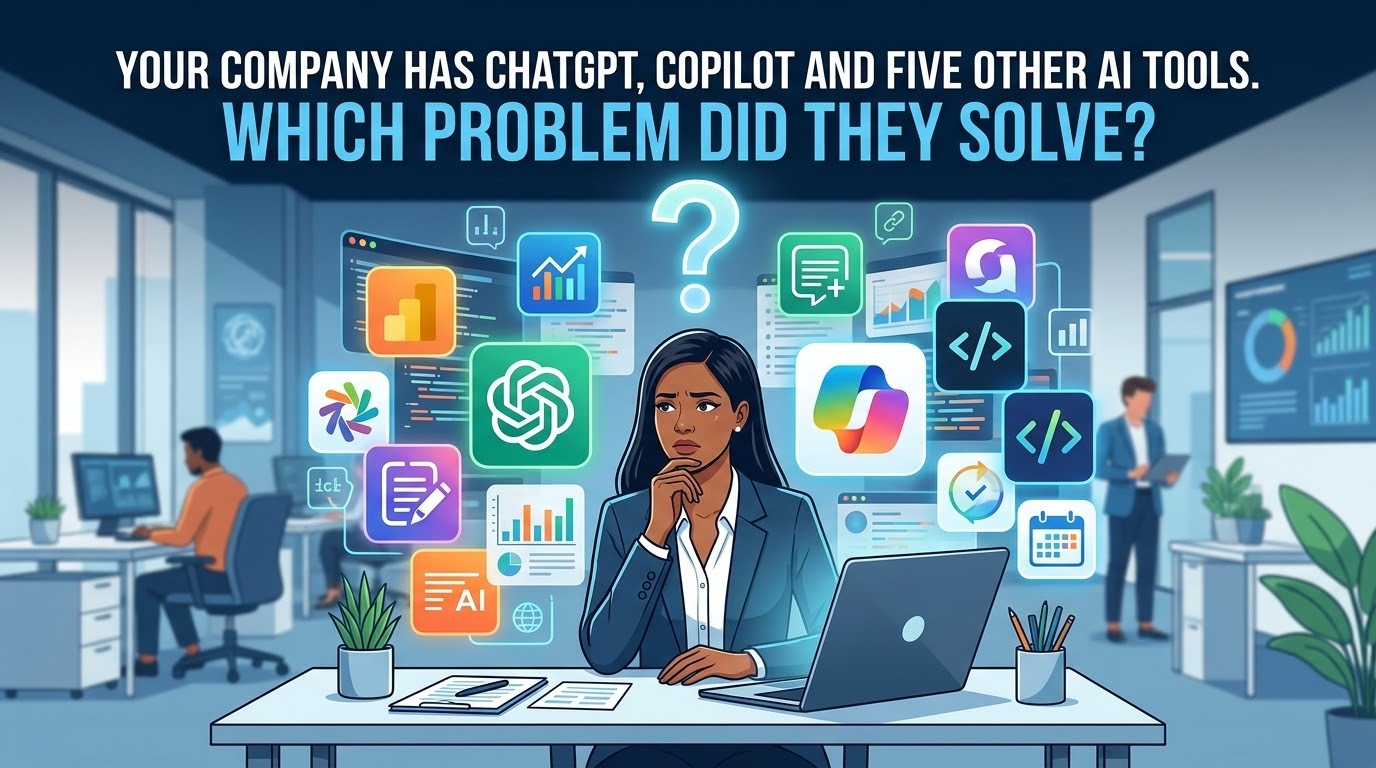
AI Has Become the New Software Shopping List
A few years ago, a company’s technology discussions might have focused on accounting software, customer relationship management systems, cloud storage or collaboration platforms. Today, artificial intelligence has joined almost every technology conversation. One department wants ChatGPT. Another wants Microsoft Copilot. Marketing experiments with AI writing and design tools, customer service explores automated assistants, finance considers AI-powered accounting features, and employees quietly subscribe to their own preferred applications. Before long, management can proudly say that the organisation is using AI across the business. But there is a more important question that often receives much less attention: which business problem did all these tools actually solve? Having access to artificial intelligence is not the same as improving a business. If employees now have seven AI tools but customers are still waiting too long, managers are still overloaded, employees are still working late and the same administrative problems continue appearing every month, the company may have adopted more technology without meaningfully changing how it operates.
Buying AI Is Much Easier Than Defining the Problem
Technology purchasing is attractive because it creates a visible sense of progress. Management approves a subscription, employees receive access, training sessions are organised and everyone begins experimenting with new features. Defining the underlying business problem is harder. If employees say they are too busy, is the problem really that writing takes too long? Perhaps they spend hours waiting for approvals. Maybe customer information is scattered across several systems. Perhaps the same data is entered three times, responsibilities are unclear or managers insist on reviewing routine work that should already be delegated. An AI writing assistant may make one task dramatically faster while leaving the actual bottleneck untouched. Before choosing a tool, management should therefore be able to complete a simple sentence: “We are introducing this because we need to reduce or improve ______.” If nobody can clearly fill in that blank, the organisation may be starting with technology and searching for a problem afterwards.
“We Need AI” Is Not a Business Objective
Imagine a managing director returns from a conference and announces that the company needs an AI strategy. The instruction sounds modern and urgent, but employees may interpret it in completely different ways. Marketing thinks it means generating content faster. Finance thinks it means automating data entry. Human resources wants assistance preparing documents. Sales wants faster proposals. Operations wants forecasting. Management eventually approves several tools because each department can demonstrate a possible use. Six months later, the company has certainly increased its AI usage, but nobody can clearly say whether customer response times improved, operating costs fell, revenue increased or employees gained meaningful capacity. “Use more AI” is an activity, not an outcome. A useful objective sounds different: reduce proposal preparation from three hours to one hour, cut invoice-processing errors by half, answer standard customer enquiries within five minutes or reduce the time managers spend preparing weekly reports. Once the desired outcome is clear, technology becomes a means rather than the goal.
Seven AI Tools Can Create Seven New Subscriptions Without Creating Seven Improvements
Subscription costs can appear harmless individually. One AI platform costs S$30 per employee each month, another S$20, another S$50 for selected users, and several specialised applications charge by usage. None seems particularly expensive when management considers each request separately. But a company with dozens or hundreds of employees can gradually accumulate a significant annual technology bill. More importantly, the financial cost is only part of the issue. Employees need to learn the tools, administrators need to manage access, IT needs to consider security, managers need to establish policies and teams need to decide which application should be used for which task. If multiple products perform similar functions, the company may actually create additional complexity. The right question is therefore not whether each subscription is affordable. It is whether the organisation receives enough measurable value from the entire collection of tools to justify the money, time and attention being invested.
Employees May Use Different AI Tools to Solve the Same Problem
One employee prepares meeting summaries using ChatGPT. Another uses Copilot. A third uploads notes into a specialised meeting assistant. Marketing has another application for summarising documents, while management subscribes to a separate platform because it was recommended at an industry event. Each employee may genuinely be working more efficiently, yet the organisation as a whole could be duplicating capabilities. This often happens when AI adoption grows organically without a coordinated view of what tools are already available. The company eventually discovers that it is paying for several products that perform overlapping functions. Consolidating them does not necessarily mean choosing one AI tool for everything. Different applications may genuinely be better for different jobs. However, management should understand where duplication exists and whether the additional capability is worth its cost. Otherwise, technology spending grows because every department optimises independently while nobody optimises for the company.
A Tool Can Save Time Without Saving the Company Any Time
Suppose an employee previously spent two hours preparing a weekly report. AI reduces the task to 30 minutes, saving 90 minutes every week. That sounds like a clear productivity improvement. But what happens to the 90 minutes? If the employee simply fills the time with more emails, additional meetings or other low-value administrative work, the organisation may never capture the benefit. Time saved at task level does not automatically become productivity at company level. Management needs to understand what employees should do with newly available capacity. Perhaps the employee can manage more customers, perform deeper analysis, improve quality, shorten turnaround times or take responsibility for work that previously required another person. AI creates potential capacity. The organisation still needs to convert that capacity into an outcome.
Faster Work Does Not Matter If the Work Immediately Starts Waiting
Consider a proposal that previously required three hours to prepare. With AI assistance, an employee completes the first draft in 30 minutes. An impressive improvement has occurred at the task level. The proposal then waits until tomorrow for a manager to review it. After review, it waits another day for a director’s approval. The customer eventually receives it three days later, exactly as before. From the employee’s perspective, AI made the work much faster. From the customer’s perspective, nothing changed. This illustrates why businesses should examine entire processes rather than individual tasks. The slowest part may not be creating the document at all. It may be approval, handover, missing information or unclear responsibility. Automating the fastest-improving part of a process while ignoring its bottleneck can create impressive internal statistics without improving the outcome that matters.
More Output Is Not Automatically More Productivity
Generative AI makes it possible to create more material with less effort. Marketing can produce more social posts, sales can generate more prospecting emails, managers can prepare more reports and employees can create more presentations. The question is whether the business needed more of those things. If a marketing department previously published eight useful articles per month and can now produce 30, publishing 30 is not automatically better. If customers receive five times more sales emails but response rates fall, output increased while effectiveness deteriorated. Productivity should not be confused with volume. Genuine productivity means creating more useful value from the same or fewer resources. Sometimes AI should allow a company to produce more. In other situations, the correct outcome is producing the same amount faster, producing less but improving quality, or eliminating unnecessary work altogether.
AI Can Make a Bad Process Run Faster
Imagine an employee receives information by email, manually transfers it into a spreadsheet, prepares a summary, emails the summary to a manager and then copies approved information into another system. Management introduces AI to automate the summary. The employee now prepares that portion much faster, but the underlying process still involves manual transfers, duplicate data and several handovers. The company has successfully accelerated one step inside an inefficient workflow. This is an important distinction because automation can make existing processes faster without making them better. Before applying AI, businesses should ask whether every step still needs to exist. Sometimes the largest improvement comes not from automating a task but from eliminating it, combining it with another task or redesigning the flow of information.
Employees May Be Solving Problems Management Does Not Know Exist
One useful consequence of widespread AI adoption is that employees often reveal where work is unnecessarily difficult. If half the finance team uses AI to reformat reports every month, perhaps the reporting process should be redesigned. If sales employees constantly use AI to rewrite information from one system into another, integration may be the real problem. If managers depend on AI to summarise enormous internal documents, perhaps those documents have become unnecessarily long. Instead of viewing employee AI usage only as a technology question, management can treat it as a clue. Where employees repeatedly use AI to overcome friction, there may be a process worth examining. The objective should not necessarily be to stop those employees. It should be to understand why the workaround became necessary in the first place.
Shadow AI Creates a Different Kind of Problem
Not every AI tool used inside a business has been formally approved. Employees may create personal accounts because they want to work faster, particularly when official systems feel restrictive. They might paste customer enquiries, internal reports, contract clauses or financial information into external applications without fully understanding how that data is handled. The employee’s intention may be entirely reasonable: finish the task quickly. From the organisation’s perspective, however, uncontrolled use creates questions about confidentiality, data protection, access management and consistency. Simply banning every unapproved tool may drive usage further underground. A stronger approach is to understand what employees are trying to accomplish, provide appropriate approved alternatives where possible and establish practical rules about what information can and cannot be entered into external AI systems.
AI Output Still Needs Someone Who Understands the Subject
A well-written answer can look convincing even when it contains an error. This creates a particular risk when employees use AI in areas they do not understand well enough to review. Someone with strong accounting knowledge can use AI to accelerate certain drafting or analysis tasks while recognising when an answer does not make sense. Someone without that knowledge may accept the same output because it sounds professional. The same applies to legal, technical, tax, compliance and commercial work. AI can reduce the effort required to produce an initial output, but it does not remove the need for judgement. In many situations, the value of experienced employees may shift away from producing every first draft manually and towards reviewing, interpreting, questioning and deciding what should happen next.
A Faster Mistake Is Still a Mistake
Automation changes the scale of errors. A person making one manual mistake may affect one transaction. An automated workflow repeating the same mistake can affect hundreds or thousands before anyone notices. Imagine an AI-supported process incorrectly classifies a certain type of transaction. If the system processes ten transactions, the issue may be manageable. If management confidently expands the automation to 20,000 transactions, the same logic can create a much larger correction exercise. This is why controls should evolve alongside automation. Businesses need appropriate review points, exception reporting and accountability for automated processes. The objective is not to manually check every output and destroy the efficiency benefit. It is to design controls that focus human attention where errors are most likely or most consequential.
AI Should Reduce Low-Value Work, Not Simply Create New Work
There is an irony in some AI programmes: companies introduce technology to save time and then create committees, reporting templates, approval processes and weekly meetings to manage the technology. Employees spend time documenting AI usage, comparing tools and attending training sessions while their original workload remains unchanged. Some governance is necessary, especially where confidential information or important decisions are involved, but it should be proportionate. If the organisation creates two hours of administration to govern a tool that saves employees one hour, the productivity equation is not particularly attractive. Management should therefore consider the full organisational cost of AI adoption, not merely subscription prices or the minutes saved during individual tasks.
Measuring Logins Does Not Tell Management Whether AI Works
Technology adoption is often measured using easily available metrics: number of licences, active users, prompts submitted or employees trained. These numbers tell management whether people are using the technology, but they do not establish whether the business is improving. A company can achieve 90% AI adoption and receive almost no commercial benefit if employees use it primarily for minor convenience. Conversely, a specialised AI application used by only ten employees could generate significant value if it removes a major bottleneck. Useful measures depend on the original problem. If the objective was faster customer response, measure response time. If it was reducing administrative effort, measure hours required. If it was improving proposal turnaround, measure the time from customer request to completed proposal. AI should ultimately be evaluated using business outcomes rather than technology activity.
The Finance Team Should Ask What the Subscription Is Replacing
When a department requests another AI tool, finance may focus on whether the subscription fits the budget. A more useful question is what the expenditure is expected to replace or improve. Does it reduce outsourced work? Does it allow employees to handle higher transaction volumes? Does it eliminate another software subscription? Does it shorten a process enough to improve customer service? Does it reduce errors or free senior employees from repetitive administration? Not every benefit must translate immediately into headcount reduction. Better quality, faster service and additional capacity can all be valuable. But the organisation should be able to describe the expected benefit in concrete terms. Otherwise, AI subscriptions can become another category of recurring expenditure that grows every year without receiving the same scrutiny as other investments.
Managers Need to Know Whether Saved Hours Became Valuable Hours
Suppose a department calculates that AI saved 5,000 employee hours during the year. That sounds impressive. At an assumed labour cost, management might even convert the number into a large theoretical saving. But if payroll remained the same, output remained the same, customer turnaround remained the same and employees continued working the same hours, the company should ask where the economic saving actually appeared. This does not mean the calculation is false. Employees may genuinely have saved 5,000 hours at individual task level. The organisation simply failed to convert those hours into measurable value. Perhaps employees used the time to improve quality, which would still be beneficial, but management should understand the outcome. “Hours saved” becomes much more meaningful when it is connected to something the business subsequently achieved.
AI Can Reveal That the Real Bottleneck Is Management
Sometimes employees become faster while managers remain the limiting factor. A team uses AI to prepare analysis, documents and customer responses quickly, but everything still requires approval from one senior person. As output increases, the manager receives even more items to review and the queue becomes longer. The technology has moved the bottleneck rather than removed it. This can be uncomfortable because the solution may have little to do with buying better AI. The company may need clearer delegation limits, stronger employee training, better standard procedures or different approval thresholds. Technology can expose organisational problems that were previously hidden by slower work. If ten employees suddenly become twice as fast but one manager must still approve everything, management capacity becomes the constraint.
The Best AI Project May Be the One That Removes an Entire Step
Businesses often ask how AI can perform an existing task faster. A better question is whether the task needs to exist at all. If employees prepare a report only because another department cannot access the original information, perhaps better access eliminates the report. If staff manually summarise data from several systems, integration may eliminate the summary process. If managers repeatedly ask the same questions, a reliable dashboard may be more useful than generating another document with AI. Process redesign should therefore come before automation where possible. The most impressive use of technology is not always making a 30-minute task take three minutes. Sometimes it is recognising that nobody needs to perform the task anymore.
Start With One Painful Problem Instead of Seven Exciting Tools
A practical AI strategy does not need to begin with a large transformation programme. Management can identify one expensive, repetitive or frustrating problem and investigate it properly. Perhaps customer quotations take too long. Maybe employees spend hundreds of hours preparing recurring reports. Perhaps customer service repeatedly answers the same basic questions. Management can document the current process, establish how much time and money it consumes, identify where errors or delays occur and then determine whether AI is actually an appropriate solution. After implementation, the company can compare the new result with the original baseline. This approach may sound less exciting than announcing an organisation-wide AI initiative, but it makes the value much easier to understand.
Sometimes the Correct Answer Is That AI Is Not the Solution
Not every business problem requires artificial intelligence. If employees cannot find documents because folders are badly organised, better document management may solve the problem. If customers wait because every discount requires director approval, delegation may be the solution. If finance repeatedly re-enters data because two systems are not connected, integration may be more appropriate. If employees do not understand a process, training may solve more than automation. AI is powerful precisely because it can address many types of work, but that flexibility can encourage organisations to apply it everywhere. Good management means choosing the simplest effective solution, even when that solution is less fashionable.
Good Financial Information Helps Management Test Whether Technology Is Delivering Value
Evaluating AI ultimately requires businesses to connect operational improvements with financial and commercial outcomes. Did technology expenditure increase while outsourcing decreased? Did revenue per employee improve? Did administrative costs change? Did customer response become faster? Did errors or rework decline? Did the business gain enough additional capacity to grow without adding the same amount of headcount? Reliable accounting and management information can help leaders evaluate these questions over time. Credon Public Accounting Corporation works with businesses across accounting, audit and related professional services, and this type of financial visibility becomes increasingly important as companies invest in new technology. The objective is not to force every AI initiative to demonstrate an immediate dollar return, but management should understand whether technology investment is moving the business in the intended direction.
AI Spending Should Eventually Face the Same Questions as Every Other Investment
Artificial intelligence may be new, but the basic discipline of investment has not changed. Businesses routinely ask whether a new employee, machine, office, marketing campaign or software system is worth its cost. AI should eventually receive the same treatment. What problem are we solving? What does the problem currently cost us? What outcome do we expect? How will we know whether it worked? What risks need to be controlled? What happens if we stop using the tool? These questions do not slow innovation. They help distinguish useful experimentation from permanent expenditure. Companies should absolutely experiment with emerging technology, but experiments should eventually produce a decision: expand it, modify it, replace it or stop paying for it.
The Goal Is Not to Have the Most AI
There will always be another tool. A new model will promise better reasoning, another application will automate presentations, another platform will analyse meetings and another vendor will claim to transform productivity. Businesses that measure progress by the number of AI products they adopt will therefore never finish. The objective should instead be to build an organisation that solves problems effectively. Sometimes AI will be the best solution. Sometimes conventional automation, better processes, clearer responsibilities or simply stopping unnecessary work will create more value. A company with two carefully chosen AI tools solving important problems can be more advanced than a company with twenty subscriptions nobody has properly evaluated.
Conclusion: Ask About the Problem Before Asking About the Tool
ChatGPT, Copilot and specialised AI applications can create genuine opportunities for businesses. They can accelerate drafting, analysis, communication, research and repetitive knowledge work, while helping employees spend less time on certain administrative tasks. But access to powerful technology does not automatically create a more productive company. Businesses still need to identify bottlenecks, redesign processes, manage information responsibly, develop employees and measure outcomes that actually matter. If a company buys seven AI tools without answering those questions, it may simply automate fragments of an organisation that continues operating much as it did before.
The Most Important AI Question Is Surprisingly Simple
At the next management meeting, instead of asking, “What other AI tools should we adopt?”, try asking a different question: “What important business problem do we still have?” Perhaps customers wait three days for quotations. Perhaps managers spend too much time approving routine decisions. Perhaps finance performs repetitive manual work every month. Perhaps employees cannot find information, or the business is struggling to grow without continuously adding headcount. Once the problem is clear, management can determine whether ChatGPT, Copilot, another AI application, conventional software, process redesign or something much simpler is the right solution. If the company cannot identify what changed after introducing AI, having more AI is not necessarily progress. The real competitive advantage will belong to businesses that become better at solving problems, not merely better at collecting tools.