
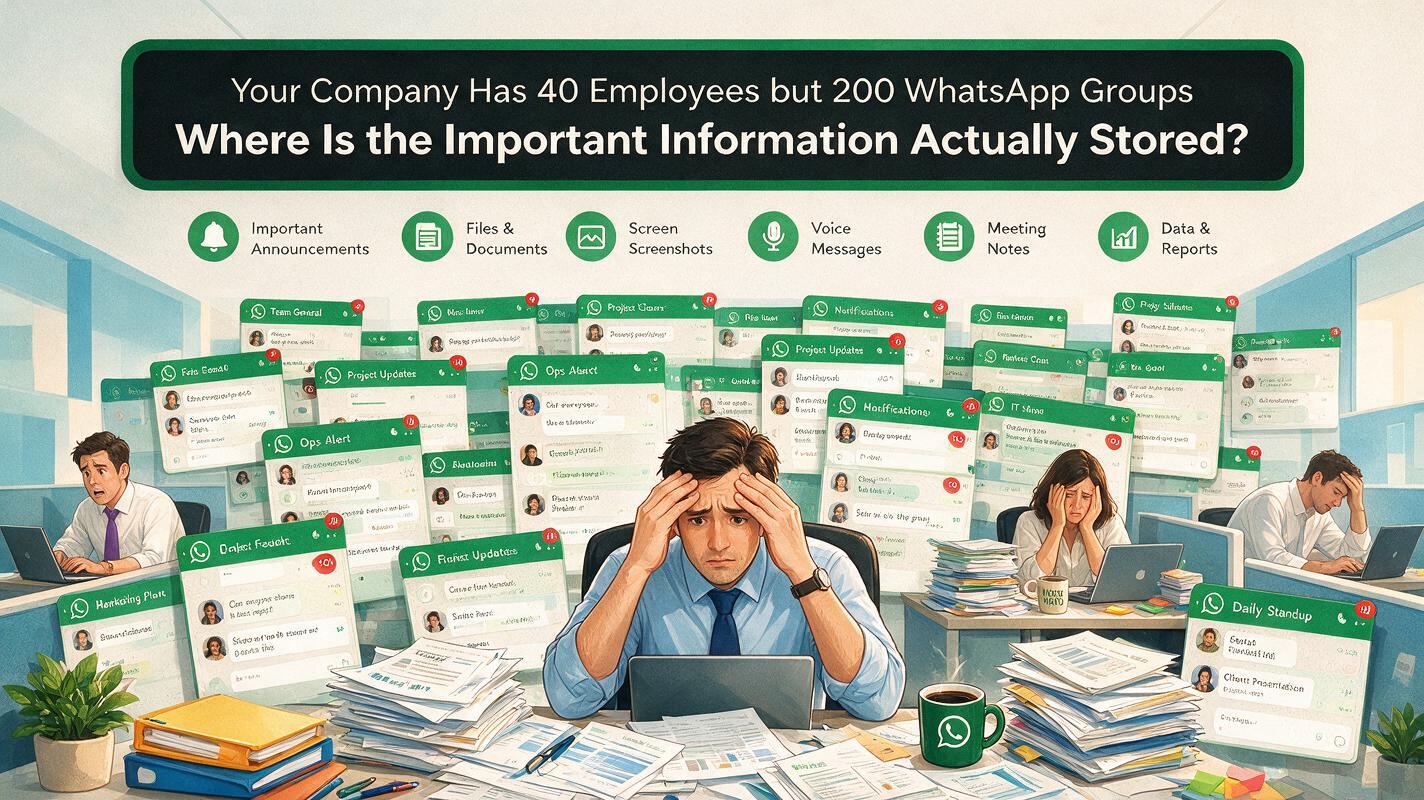
The Business Has Gone Digital, but Finding Information Has Somehow Become Harder
Your company has 40 employees, several departments, dozens of customers and more WhatsApp groups than anyone can realistically count. There is a group for management, another for finance, separate groups for individual customers, a sales group, an operations group, a project group, a group for urgent matters and several temporary groups created for projects that ended two years ago but somehow still receive messages. Employees also communicate through personal WhatsApp chats, email, shared cloud folders, accounting software and spreadsheets. On the surface, the company looks highly connected because information can move from one person to another almost instantly. Yet ask a simple question such as, “Who approved this S$20,000 customer discount six months ago?” and suddenly nobody knows where to look. Someone remembers discussing it on WhatsApp. Another employee thinks an email was sent. The salesperson says the previous manager approved it verbally. Finance has an invoice showing the final amount but cannot find the original approval. The problem is not that the company lacks information. The problem is that important information exists everywhere, which increasingly means nobody knows exactly where the official version is stored.
WhatsApp Became Business Infrastructure Without Anyone Planning It
Most companies never formally decide that WhatsApp will become part of their operational infrastructure. It happens gradually because the application is convenient. An employee needs an immediate answer, so they send a message. A customer creates a group because email feels too slow. A manager sends a photograph of a document because scanning it would take longer. Employees discuss a quotation, approve a small change and continue working. Everything moves quickly, which is exactly why messaging applications become deeply embedded in business operations. The problem appears later when temporary communication begins functioning as permanent documentation. A message that was convenient for resolving today’s problem may become important evidence six months later, but nobody thought about preserving it because everyone treated the conversation as informal.
Fast Communication and Good Record Keeping Are Different Things
WhatsApp is excellent at answering, “What is happening right now?” It is less naturally suited to answering, “What exactly did we agree on eight months ago?” A busy group may receive hundreds of messages every week. Important decisions become surrounded by photographs, jokes, reminders, customer comments, delivery updates and unrelated conversations. Employees can search messages, but that assumes they remember the right keyword, know which group contained the discussion and still have access to the relevant chat. Business records need to remain understandable even when the person searching for them was not involved in the original conversation. That is where informal messaging and formal documentation begin to serve very different purposes.
The Real Problem Is Not WhatsApp Itself
Businesses do not necessarily need to ban WhatsApp. Doing so could create more problems than it solves, especially when employees and customers rely on it for quick communication. The more important question is what information should remain only inside WhatsApp and what information should eventually be transferred into a proper business record. “Customer arriving at 3 pm instead of 2 pm” probably does not need permanent documentation. “Customer approved an additional S$80,000 scope of work” is very different. Companies need to distinguish between conversation and record, because treating every message as unimportant creates risk while treating every message as a formal document creates unnecessary administration.
One Customer Can Generate Information Across Five Different Places
Imagine a customer requests a quotation through email. The salesperson discusses pricing with the sales manager on WhatsApp. Management approves a discount in a separate management group. The final quotation is saved in a shared drive. The customer asks for additional work through a personal WhatsApp conversation with the salesperson. Finance issues the invoice through the accounting system. Several months later, the customer disputes the amount and claims the additional work was included in the original price. Where is the complete story? Part of it is in email, part is in WhatsApp, part is in the cloud drive and part is in the accounting system. Each system contains information, but no single location contains enough information to explain what happened from beginning to end.
The Employee Who Remembers Everything Becomes the Company’s Search Engine
Many SMEs solve fragmented information through human memory. Someone asks what happened with Customer A and everyone turns to Sarah because Sarah handled the account. Sarah remembers that the customer originally requested one service, negotiated a discount and later added another requirement. She even remembers approximately when the WhatsApp conversation occurred. This works surprisingly well until Sarah goes on leave, transfers departments or resigns. Suddenly, the company discovers that part of its information system was actually one employee’s memory. The organisation did not have a reliable record of the customer relationship. It had Sarah. Businesses should appreciate experienced employees, but important information should remain accessible without requiring the continued presence of a particular individual.
Resignations Reveal How Much Information Was Never Really Owned by the Company
The problem becomes especially visible when employees leave. A salesperson resigns after five years and management suddenly needs to understand dozens of customer arrangements. Some information exists in the company’s CRM. Some is stored in email. But years of important context may also exist in WhatsApp conversations, including personal chats conducted using the employee’s own phone. Customers continue expecting the company to remember everything previously discussed, even though the person who held much of that information has disappeared. A proper handover becomes difficult because nobody can realistically summarise five years of conversations during the employee’s final week. Companies should therefore build systems that capture important decisions while employees are still working rather than trying to reconstruct everything during resignation handovers.
Customer Relationships Should Belong to the Business, Not One Employee’s Phone
Strong personal relationships are valuable in sales and professional services, but the commercial relationship ultimately needs to belong to the organisation. If a customer has negotiated special payment terms, unusual pricing, service commitments or contractual exceptions, that information should not exist only inside a salesperson’s WhatsApp history. The company needs enough formal documentation for another employee to understand what was agreed. Otherwise, changing account managers can create confusion, inconsistent service and disputes. The customer may reasonably say, “Your previous manager already agreed to this,” while the new manager has no reliable way to verify the statement.
“Boss Said Okay” Is Not a Strong Approval System
Many small companies have a familiar approval process. An employee sends a message to the managing director: “Boss, customer asking additional 10% discount, can?” The managing director replies, “Okay.” The employee proceeds. Six months later, finance asks why the customer received an unusual discount. The salesperson responds, “Boss approved.” Management asks for the approval and receives a screenshot of a conversation with almost no context. Which quotation was being discussed? Did “okay” mean approve the discount or approve sending a revised proposal? Was there a condition attached? Informal approvals can work for routine matters, but financially significant decisions benefit from a process that makes the amount, purpose, approver and outcome clear.
Screenshots Are Useful Evidence but Terrible Information Architecture
When companies realise WhatsApp contains important information, employees often start taking screenshots. This can preserve a conversation, but it creates another problem. The screenshot becomes an image called something like IMG_4832.jpg sitting inside a folder with hundreds of other images. Nobody knows what it relates to unless they open it. Screenshots may also omit earlier context or later messages that changed the decision. They can be useful supporting records in appropriate situations, but they are not a substitute for a structured documentation process. A better approach may be to record the final decision in the relevant system or file and use the conversation only as supporting context where necessary.
The Finance Team Often Discovers the Information Problem Last
Sales and operations can function for months using informal communication because the employees involved know what is happening. Finance encounters the consequences later. An invoice needs to be prepared, but nobody can confirm the final price. A customer pays less than invoiced and claims a discount was agreed. A supplier invoice arrives for an amount higher than expected, and operations says management approved additional work through WhatsApp. Finance then becomes the department trying to reconstruct decisions made weeks or months earlier. The accounting records may show the financial outcome, but they do not automatically explain the commercial decisions that produced it.
An Invoice Records the Amount, Not the Entire Story
Suppose the accounting system shows a S$75,000 invoice. That tells finance what the customer was billed. It does not necessarily explain why the amount is S$75,000 rather than S$90,000. Perhaps there was a discount. Perhaps part of the work was cancelled. Perhaps management agreed to absorb an additional cost. The accounting system records the transaction, but supporting commercial documentation helps explain it. This is why good financial records depend partly on good operational records. Accounting cannot magically recreate decisions that were never properly documented elsewhere.
Supplier Arrangements Can Become Equally Confusing
The same problem appears on the purchasing side. A supplier originally quotes S$40,000. Operations later requests additional work through WhatsApp. The supplier says the additional cost is S$8,000. Someone replies, “Proceed.” The final invoice arrives for S$48,000, but the purchase order still shows S$40,000. Finance asks why the invoice is higher. Operations searches several WhatsApp groups trying to locate the approval. What should have been a straightforward payment becomes a small investigation. If this happens repeatedly across dozens of suppliers, fragmented communication can consume significant administrative time.
A Growing Company Cannot Operate Forever on “Everyone Knows”
When a business has six employees, informal communication can be extremely effective because everyone has broad visibility. Someone mentions a customer issue during lunch and the entire company effectively knows about it. At 40 employees, information no longer spreads reliably through personal familiarity. Sales may know something finance does not. Operations may agree to something management has not seen. New employees may have no idea about arrangements made before they joined. Growth therefore creates a need for more deliberate information management. The company does not need to become bureaucratic, but it can no longer assume that important knowledge will naturally reach everyone who needs it.
More Employees Create More Communication Paths Than Most Owners Expect
The complexity of communication grows much faster than headcount. A larger organisation has more departments, projects, managers and customer relationships, each producing its own discussions and decisions. Employees create additional groups because existing groups contain too much unrelated information. Then subgroups appear because not everyone needs every message. Eventually, the company has solved information overload by creating information fragmentation. Each group becomes easier to manage individually, but the organisation as a whole becomes harder to understand. Nobody intentionally designed this structure. It emerged one chat at a time.
The Same Decision Can Have Five Different Versions
Another danger appears when employees discuss the same issue across multiple channels. A draft proposal is emailed. Management comments in WhatsApp. The salesperson updates a spreadsheet. Operations receives an older PDF. The customer approves a revised version through another message. Finance later finds three different prices and asks which one is final. Version control sounds like an IT problem, but it quickly becomes a financial problem when different versions contain different amounts, quantities or contractual terms. The company needs a reliable way to identify the final approved document rather than expecting employees to remember which attachment was the correct one.
“Final_FINAL_v3_Approved.pdf” Is a Warning Sign
Almost every business has experienced this. A shared folder contains Quotation.pdf, Quotation Revised.pdf, Quotation Final.pdf, Quotation Final2.pdf and Quotation FINAL APPROVED.pdf. Employees laugh about the file names because they are familiar, but the underlying problem is serious. If there is no clear version-control practice, someone can easily use an outdated document. Messaging applications can make this worse because old attachments remain available in chat histories and may be forwarded months later. Clear naming conventions and central storage may sound boring, but they can prevent expensive misunderstandings.
Cloud Storage Does Not Automatically Solve the Problem
Businesses sometimes believe moving everything into Google Drive, OneDrive or another cloud platform solves information management. Cloud storage certainly makes files easier to share, but the underlying organisation still matters. If every employee creates folders differently, duplicates documents and stores files without consistent naming, the company simply moves the mess from local computers into the cloud. Technology provides storage. It does not decide which document is official, who owns it or how information should be organised. A well-designed process is still necessary.
AI Makes Good Information Management Even More Important
The growing use of artificial intelligence adds another reason to improve business records. AI tools can summarise documents, analyse data, draft reports and help employees retrieve information more quickly, but their usefulness depends heavily on the quality and accessibility of the underlying information. If the real explanation for a customer arrangement exists only inside a three-year-old WhatsApp conversation on a former employee’s phone, no sophisticated AI system can reliably analyse information it cannot access. Businesses that want to benefit from AI therefore need to think about information quality before assuming technology will solve information fragmentation.
Bad Data Plus AI Can Produce Faster Confusion
Imagine asking an AI system to summarise the company’s customer profitability when customer discounts are recorded inconsistently, contract changes are undocumented and several important commercial arrangements exist only in messaging applications. The AI may process the available numbers very quickly, but speed does not guarantee completeness. Technology can accelerate analysis, yet management still needs confidence that the information being analysed reflects reality. The same principle applies to automated accounting, dashboards and reporting. Better tools increase the value of good information and can magnify the consequences of bad information.
Not Every WhatsApp Message Needs to Become a Corporate Record
The solution should not be to save every “okay,” “thanks” and lunch discussion into a formal database. That would overwhelm employees and probably make the documentation problem worse. Companies need sensible criteria for identifying information worth preserving. Significant pricing changes, contract amendments, customer commitments, unusual payment terms, major supplier decisions, financial approvals and other material matters are more likely to require formal records than ordinary daily coordination. The objective is to capture decisions with continuing business significance, not archive every conversation forever.
Decide Where the Final Truth Should Live
One of the most useful questions management can ask is: Where should the final version of this information live? Customer contact information might belong in a CRM. Final contracts may belong in a controlled document repository. Financial transactions belong in the accounting system. Approved quotations may belong in a customer folder. Employee records belong in the appropriate HR system. The exact tools vary by company, but the principle is powerful. Employees can communicate through multiple channels, yet everyone should know where to find the authoritative record when the conversation is over.
WhatsApp Can Be the Conversation Without Being the Database
This distinction allows businesses to preserve the speed employees like. A salesperson can still ask management a quick question through WhatsApp. Once a significant decision is reached, however, the final outcome can be recorded appropriately. If management approves a major discount, the approved quotation or CRM record should reflect it. If a supplier’s scope changes, the purchase order or relevant documentation should be updated. WhatsApp remains useful for communication, but the organisation no longer depends on searching old chats to understand important transactions.
Approval Workflows Should Match the Size of the Decision
A company does not need a complicated approval platform for every S$20 purchase. Controls should be proportionate. Small routine matters may be handled informally within established limits, while larger decisions require clearer documentation. For example, department managers might have authority to approve spending within defined thresholds, while larger expenditures require formal approval. Customer discounts above a certain percentage might need management authorisation recorded in the sales system. The point is not to eliminate flexibility. It is to make significant decisions traceable.
Documentation Protects Employees Too
Employees sometimes view documentation as management trying to monitor them, but clear records can also protect staff. Imagine a salesperson is accused of giving an unauthorised S$30,000 discount. If the approval exists only as a vague conversation, the employee may struggle to prove that management agreed. A clear record protects both the company and the employee by showing what was decided and who approved it. Good documentation reduces arguments based on memory because the organisation does not need to decide whose recollection is more accurate.
Memory Changes, but Records Do Not Need To
Two people can participate in the same conversation and remember it differently six months later. This does not necessarily mean anyone is dishonest. Human memory is imperfect, particularly when employees handle hundreds of transactions and discussions. A manager may genuinely believe they approved only a 5 per cent discount while the salesperson remembers 10 per cent. A clear written record removes unnecessary ambiguity. Businesses should not build financially significant processes around the assumption that everyone will remember every detail correctly.
Customer Disputes Become Easier to Resolve With Good Records
A customer says additional work was included in the original price. Your team says it was separately chargeable. If the agreement is clearly documented, the conversation can focus on resolving the commercial issue. If documentation is weak, the dispute becomes a debate over memory. Good records do not guarantee that customers will never dispute invoices, but they give the company a much stronger foundation for explaining what was agreed. This can also reduce the time senior management spends investigating old conversations.
Audit and Financial Reporting Can Expose Weak Documentation
Businesses often discover documentation weaknesses when financial information needs independent support. An unusual transaction appears in the accounts and someone needs to explain why it occurred. Finance asks operations. Operations asks sales. Sales searches WhatsApp. Eventually someone finds a screenshot. The accounting entry may be perfectly legitimate, but proving and explaining the transaction becomes unnecessarily difficult. This is one reason organisations should treat documentation as part of financial discipline rather than merely administrative housekeeping.
A Clean Accounting System Cannot Fix Missing Commercial Context
An accounting system can accurately record S$100,000 of revenue, but it cannot automatically explain the contract terms behind that revenue if nobody retained the agreement. It can record a S$60,000 supplier payment but cannot explain why management agreed to an additional S$15,000 of work if that approval exists only in an old chat. Businesses therefore need alignment between financial systems and operational documentation. Strong bookkeeping is extremely valuable, but it works best when the transactions being recorded are supported by organised business records.
Access Control Matters as Much as Storage
Where information is stored is only one part of the problem. Companies should also consider who can access, change or delete important records. A shared folder accessible to every employee may be convenient, but sensitive financial, customer or employee information may require more appropriate restrictions. Conversely, storing critical information in one employee’s private folder creates dependency. Businesses need a balance between accessibility and control so the right people can retrieve information without exposing it unnecessarily.
Personal Phones Create Another Layer of Business Risk
Many SMEs allow employees to communicate with customers using personal mobile phones because it is convenient and inexpensive. But when significant business information is stored on personally controlled devices, ownership and continuity become more complicated. What happens when the employee leaves? What if the phone is lost? What if chat history is deleted? What if another employee needs information while the person is on leave? Companies should think carefully about how business-critical communications are preserved rather than assuming information will remain available forever simply because it was once sent through WhatsApp.
The Handover Process Should Not Begin Two Days Before Someone Leaves
When an employee resigns, companies often create a handover spreadsheet listing current customers, pending work and outstanding tasks. That is useful, but it cannot reconstruct years of undocumented knowledge. Effective continuity comes from normal operating practices that preserve important information throughout employment. If customer agreements, pricing arrangements, key contacts and ongoing issues are maintained in shared systems, the handover becomes a review rather than an archaeological expedition through thousands of messages.
Finance Teams Benefit When Information Has Clear Ownership
Companies should decide who owns different types of records. Sales may own quotations and customer commercial arrangements. Operations may own project documentation. Finance owns accounting records and payment documentation. HR owns employee records. Management owns certain approvals and policies. Ownership does not mean only that department can see the information. It means someone is responsible for ensuring the record is complete and maintained. Without ownership, everyone assumes somebody else is keeping the document.
Monthly Closing Can Reveal Information Gaps Early
The month-end accounting process can act as a useful check on documentation. If finance repeatedly needs to ask why transactions occurred, where invoices are stored or who approved certain expenditure, management can identify recurring information weaknesses before year-end. Rather than treating each query as an isolated annoyance, the company can ask whether the underlying workflow needs improvement. A recurring missing-document problem is usually a process problem, not simply a forgetful-employee problem.
The Best System Is the One Employees Will Actually Use
Companies sometimes respond to information problems by purchasing complicated enterprise software with dozens of mandatory fields. Employees hate it, so they continue using WhatsApp and update the official system only when management reminds them. Now the company has two information systems instead of one. Any solution needs to fit the organisation’s actual workflow. If recording a decision takes fifteen minutes, employees will look for shortcuts. If it takes thirty seconds and clearly helps their work, adoption becomes much easier.
Do Not Digitise Bureaucracy for the Sake of Looking Professional
Good information governance does not mean every SME needs the processes of a multinational corporation. A 40-person company should not require a seven-stage approval workflow for ordering printer paper. Excessive bureaucracy can slow employees and encourage them to bypass official systems. The objective is to identify information that matters financially, operationally or commercially and create proportionate ways to preserve it. Simple systems used consistently are often more valuable than sophisticated systems employees avoid.
Start With the Decisions That Could Cost the Company Money
If management does not know where to begin, focus first on financially significant information. How are large purchases approved? Where are customer discounts recorded? Where are signed contracts stored? How are changes to supplier bank details verified? Where are unusual payment terms documented? Who can approve refunds? Where are major project variations recorded? These questions quickly identify situations where losing a WhatsApp conversation could create a real financial consequence.
Then Look at Information That Keeps the Business Running
The next category involves operational continuity. Which customer arrangements does only one employee understand? Which recurring tasks depend on somebody remembering a deadline? Are important passwords or access rights controlled appropriately? Does another employee know how to complete payroll if the usual person is unavailable? Can management find supplier contacts without asking one specific employee? The goal is to reduce unnecessary dependence on individual memory while preserving the expertise those employees bring.
Use Technology to Support the Process, Not Replace Thinking
CRM systems, accounting software, document-management platforms and workflow tools can all help organise business information. Companies such as Credon PAC also support businesses through accounting, bookkeeping, audit, tax and related professional services, areas where organised and reliable financial information becomes increasingly important as an organisation grows. But no software can independently decide what the company considers an important record. Management first needs to define responsibilities, approval requirements and where final information should be maintained. Technology can then make that process easier and more consistent.
The Company’s Information Should Survive the People Who Created It
A healthy organisation should be able to retain important knowledge even as employees change. That does not mean every detail of an employee’s experience can be documented. Human expertise will always matter. But fundamental information about customers, suppliers, financial arrangements, contracts and important decisions should remain with the business. If losing one employee means losing years of commercial history, the company has an information continuity problem.
The Bigger the Business Becomes, the More Expensive Confusion Gets
When a company generates S$500,000 of annual revenue, a poorly documented S$1,000 decision may be irritating. When the company generates S$50 million, undocumented decisions can involve much larger amounts and more stakeholders. Growth increases the value of reliable information because more customers, employees and transactions depend on it. Processes that felt perfectly adequate during the startup stage can therefore become risky as the organisation expands.
Information Quality Is Becoming a Competitive Advantage
Businesses increasingly compete on speed. Customers expect fast quotations, management wants real-time reports and employees expect information immediately. The company that can retrieve reliable information quickly has an advantage over one that spends hours searching emails and WhatsApp histories. Good information management is therefore not simply about compliance or avoiding disputes. It can make employees faster, improve customer service and allow management to make decisions with greater confidence.
The Question Is Not Whether Employees Should Stop Using WhatsApp
Trying to eliminate every informal communication channel misses the real issue. Employees will naturally choose tools that make communication convenient, and businesses benefit from that speed. The better question is whether the company has a process for converting important conversations into reliable organisational records. WhatsApp can remain where discussions happen. Email can remain where formal correspondence happens. Meetings can remain where people make decisions. But once an important decision has been made, the business should know where the final outcome belongs.
A Simple Rule Can Prevent a Lot of Confusion
Management does not necessarily need a 100-page information governance policy. A simple principle can already improve behaviour: if the decision affects money, contractual obligations, customer commitments or important business operations, ask whether someone who was not part of the conversation could understand it six months later. If the answer is no, the information probably needs to be recorded somewhere more reliable. This test forces employees to think beyond today’s conversation and consider the future person who may need to understand what happened.
Conclusion: Your Company Does Not Have an Information Shortage. It Has an Information Location Problem
Forty employees.
Two hundred WhatsApp groups.
Thousands of emails.
Hundreds of spreadsheets.
Cloud folders.
Accounting software.
Customer systems.
Personal phones.
Shared drives.
The company has never possessed more information.
Yet somebody asks:
“Who approved this?”
And everyone starts searching.
That is the warning sign.
The problem is not necessarily WhatsApp.
The problem is not email.
The problem is not spreadsheets.
The problem appears when nobody knows which system contains the official answer.
Fast-growing businesses naturally accumulate communication channels because each new tool solves an immediate problem. WhatsApp makes communication faster. Cloud storage makes documents easier to share. Accounting software organises transactions. CRM systems organise customer information. Email creates formal communication.
Each tool can be useful.
The risk appears when important information becomes fragmented between all of them.
A customer discount should not depend on one salesperson remembering a WhatsApp conversation.
A S$50,000 supplier variation should not require finance to search six months of group messages.
A customer relationship should not disappear when an employee changes phones.
An important approval should not exist only as a screenshot nobody can find.
And the company should not discover during an audit, dispute or employee resignation that its most important business records were actually stored inside people’s memories.
Businesses do not need to document every conversation.
They need to identify which conversations become decisions.
Then those decisions need somewhere reliable to live.
As organisations grow, information management becomes part of financial management because contracts, approvals, prices, supplier arrangements and customer commitments eventually become numbers in the accounts.
Better records make those numbers easier to understand.
Better documentation makes responsibilities clearer.
Better systems reduce dependency on individual employees.
And better information allows management to spend less time asking:
“Where did we discuss this?”
and more time deciding:
“What should we do next?”
So perhaps the question is not:
“Why does our company have 200 WhatsApp groups?”
The more useful question is:
“If every one of those groups disappeared tomorrow, which important business decisions would disappear with them?”
Whatever comes to mind probably should not be stored only in WhatsApp.