
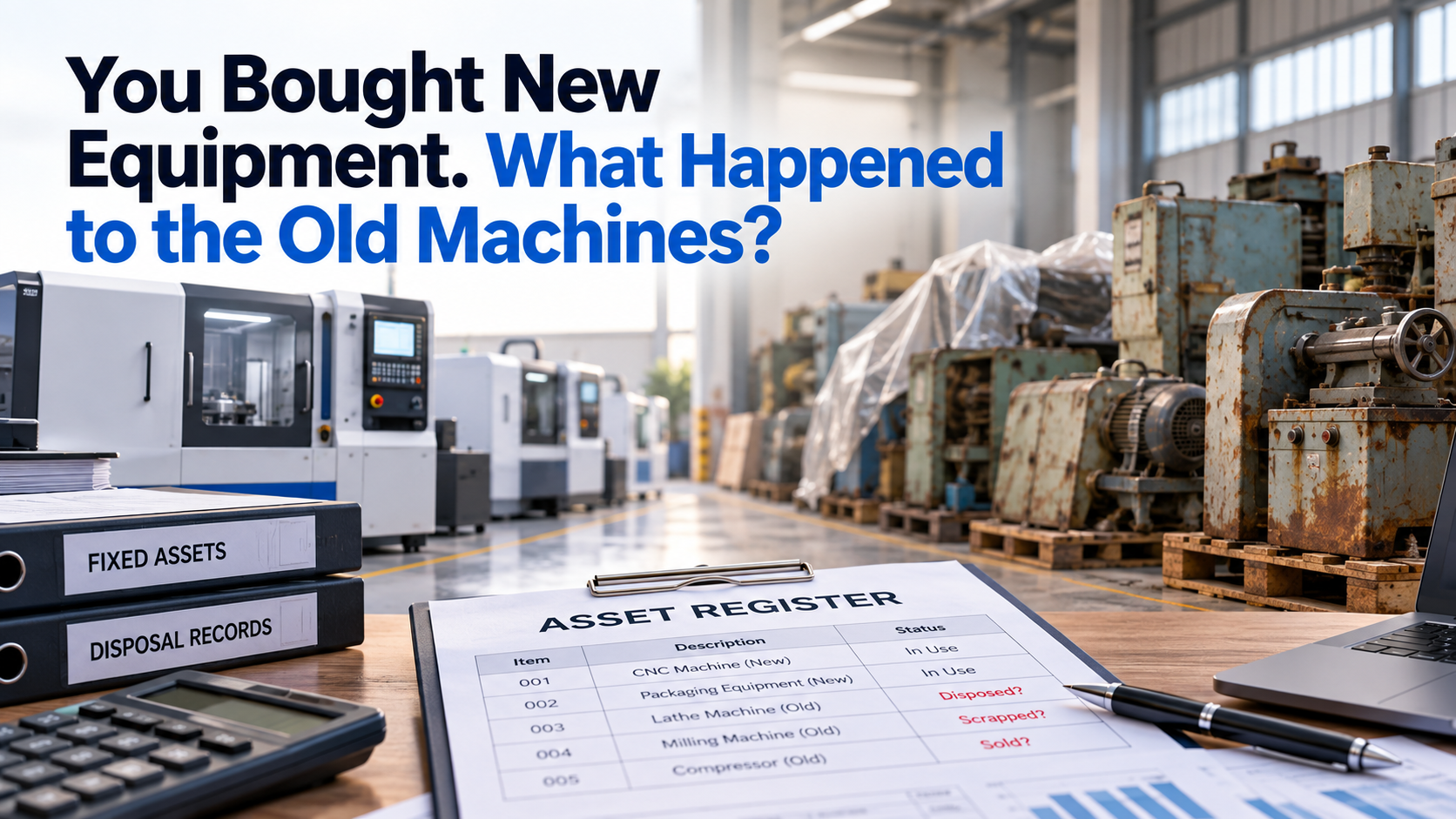
The new machine has arrived, the installation is complete, and the production team is learning how to use it. Management is looking forward to faster output, fewer breakdowns and more consistent quality. The purchase invoice goes to finance, and the equipment is added to the company’s records.
Meanwhile, the old machine is moved to a corner of the workshop. Someone suggests keeping it as a backup. Another employee thinks a second-hand dealer might buy it. A few months later, nobody is entirely sure what was decided, but the machine is still taking up space.
This is a familiar situation for businesses that use machinery, kitchen equipment, printing systems or workshop tools. The new purchase receives careful attention because money is being spent. What happens to the equipment it replaces can receive much less attention, even though the decision affects asset records, operating costs and the accounts.
A proper equipment replacement process should follow both machines: the one entering service and the one leaving its previous role.
Start by Finding Out What Actually Happened
Before deciding how to update the accounts, establish the old equipment’s location and condition. It may still be operating during peak periods, waiting for repairs, stored off-site, offered for sale or already collected by a scrap dealer.
These situations should not all be recorded as “old equipment.” That description tells management very little about whether the machine still serves a purpose or whether further action is needed.
Ask the person responsible for the equipment to confirm its asset tag or serial number, location, operating condition and last date of use. Where useful, take a dated photograph and attach it to the asset record. For equipment kept at a separate warehouse or another branch, obtain confirmation from the person managing that location.
This first step can uncover simple but important gaps. Finance may still list a machine at the original factory even though it was transferred to another site. Operations may believe it was sold, while the accounts contain no sale record. Resolving those differences gives everyone a common factual starting point.
Give Backup Equipment a Clear Purpose
Keeping an older machine as a backup can be sensible. A manufacturer may need an alternative if its main production line stops, while a commercial kitchen may retain a working oven for unusually busy periods.
However, “we might need it one day” is a weak basis for keeping equipment indefinitely. A useful backup should be capable of performing an identifiable task within a realistic period. Management should know whether it works, who can operate it and what would be needed to bring it back into service.
Consider a workshop that keeps an old cutting machine after installing a newer model. If the old machine requires unavailable replacement parts and nobody has operated it for two years, its practical value as emergency capacity deserves review. Its physical presence does not necessarily mean the business has a usable fallback.
Assign responsibility for reviewing retained equipment. A periodic check can confirm whether the original reason for keeping it still applies, whether maintenance is needed and whether changes in production have made it unsuitable. This turns an informal storage decision into a manageable business arrangement.
Compare the Cost of Keeping It with the Benefit
The purchase price of an old machine has already been incurred, but retaining it can create continuing costs. Storage space, maintenance visits, insurance and occasional repairs may all require attention.
Use actual costs wherever possible. Suppose an external storage provider charges S$250 per month specifically to hold a machine. That is S$3,000 a year before maintenance or transport costs. If management expects to keep it for another two years, the storage commitment alone would total S$6,000, assuming the monthly charge remains unchanged.
This hypothetical example does not establish that selling is the better decision. The machine might provide valuable backup capacity. It does, however, give the owner a concrete cost to compare with that benefit.
For equipment stored on company premises, distinguish cash savings from the value of freeing up space. Removing a machine will not necessarily reduce rent, but it may create room for materials, improve access or avoid the need for additional storage elsewhere. Those benefits should be described realistically when deciding whether retention is worthwhile.
Check the Asset Register Against the Workshop
The fixed asset register is the detailed record of equipment and other long-term assets. It should help the business connect the amounts in its accounts to identifiable items.
A description such as “machine purchased in June” may be sufficient when the business owns only one machine. It becomes much less useful after several years of purchases, transfers and replacements. Similar-looking equipment can easily be confused, particularly when individual units have different purchase dates and remaining book values.
Compare recorded assets with the equipment on site, then look for physical items that do not have an obvious record. Investigate differences instead of immediately deleting entries or creating new ones. Equipment may belong to a leasing company, a customer or another entity within the same group.
Where the business owns multiple similar units, asset tags and serial numbers can prevent the wrong machine from being removed from the register. Record transfers promptly so that a change of location does not later appear to be a missing asset.
Do Not Assume That Stopping Use Stops Depreciation
The accounting treatment should follow the company’s applicable Singapore reporting framework. For companies applying SFRS(I) 1-16 or FRS 16, becoming idle does not normally stop depreciation. A usage-based method can produce a zero charge during periods without production, but this differs from simply deciding to pause depreciation.
Replacing equipment should also prompt a review of its remaining useful life and residual value where circumstances have changed. Finance needs timely information about management’s plans to make that assessment.
Operations should therefore communicate more than the date the new machine started working. Explain whether the old equipment will continue in a reduced role, remain available as backup or leave the business. These details help finance assess the position instead of carrying forward assumptions made when the machine was purchased.
Likewise, a machine that has been fully depreciated may still be useful. A zero book value does not mean it should disappear from operational records while the company continues to own and use it.
Consider Whether the Remaining Value Is Recoverable
An older machine may still have a book value even after demand for its output has fallen or a replacement has made it commercially obsolete. In those circumstances, management needs to consider whether the amount recorded remains supportable.
Under SFRS(I) 1-36 or FRS 36, indicators such as damage, obsolescence or adverse changes in use can require an impairment assessment. An asset is impaired when its carrying amount exceeds its recoverable amount. That recoverable amount reflects the higher of value in use and fair value less disposal costs.
The assessment may need to cover a group of assets that generates cash flows together, rather than the machine alone. A low offer from a scrap dealer is therefore relevant evidence, but it does not automatically determine the accounting value of equipment that still contributes to a productive operation.
Management can help by providing repair estimates, usage information, realistic operating plans and available sale quotations. Finance can then assess the appropriate treatment using evidence that reflects the machine’s actual circumstances.
Document a Sale from Approval to Collection
When management decides to sell, assign someone to coordinate the transaction and provide the complete records to finance. Agree who can approve the price, communicate with the buyer and authorise collection.
The file should identify the equipment sold, the agreed amount, the buyer and the relevant handover details. Keep evidence of payment and any agreed collection or removal arrangements. If the buyer pays an employee directly, the business needs a clear record showing how the money reached the company.
For an ordinary equipment disposal, the accounting gain or loss generally compares net disposal proceeds with carrying amount. For example, assume a machine has a carrying amount of S$12,000 at disposal and net proceeds of S$9,000. The resulting loss is S$3,000, ignoring tax effects.
The amount received should therefore be connected to the correct asset record. Recording cash without updating that record can leave the accounts showing ownership of equipment that has already left the premises.
Treat Trade-Ins and Scrapping as Documented Transactions
Trade-ins can be overlooked because attention centres on the net amount payable for the replacement. A supplier may quote one figure after allowing for the old machine, leaving finance with limited information about the two pieces of equipment.
Keep the full supplier agreement, including the description of the traded-in machine and the allowance offered. Finance should assess the acquisition and disposal using the terms and applicable accounting requirements. The amount transferred through the bank does not, on its own, explain the whole transaction.
Scrapping also needs evidence, even when proceeds are small or there are none. Record who approved it, what was removed, when collection occurred and whether any payment or removal charge was involved. A collection receipt and equipment details are more useful than an unexplained message saying that the workshop has been cleared.
Under the relevant property, plant and equipment standard, disposal or the absence of expected future benefits from use or disposal can require removal from the accounts. Management should provide the evidence needed to identify when that applies.
Keep Finance Involved Before Equipment Leaves
The easiest time to capture disposal information is while the decision is being made. Months later, the employee who arranged collection may have left, the buyer’s details may be difficult to find, and the machine itself is no longer available for identification.
Introduce a short equipment movement or disposal form that suits the business. It can record the asset identifier, reason for the change, proposed action, approval and supporting documents. The purpose is to make the decision traceable without creating unnecessary paperwork.
Set a clear point at which finance must be informed. For example, operations could send the approved form before collection and provide the final handover and payment evidence afterwards. Someone should then confirm that the register and accounting records have been updated.
Tax treatment should also be reviewed separately where relevant. An accounting loss or adjustment does not, by itself, establish the tax outcome. Keeping the original purchase information and disposal documents makes that review easier.
Make Equipment Replacement a Complete Process
A replacement project is financially complete when the business can explain both the new asset and the equipment it displaced. Management should know what remains in use, what is being retained for a reason and what has left the company.
A practical starting point is to review the machines replaced during the past year. Match each one to its register entry, confirm its current status and identify any missing decisions or documents. Give unresolved items an owner and a date for follow-up so that the review produces action.
Credon provides accounting and audit services that can support businesses in reviewing their asset records and the financial reporting implications of equipment changes. Clear information from operations gives those reviews a stronger foundation.
The next equipment purchase is an opportunity to improve the process. Alongside approval for the new machine, decide who will assess the old one, document its future and notify finance. That small addition helps prevent an expensive asset from becoming an unexplained item in storage or an outdated balance in the accounts.