
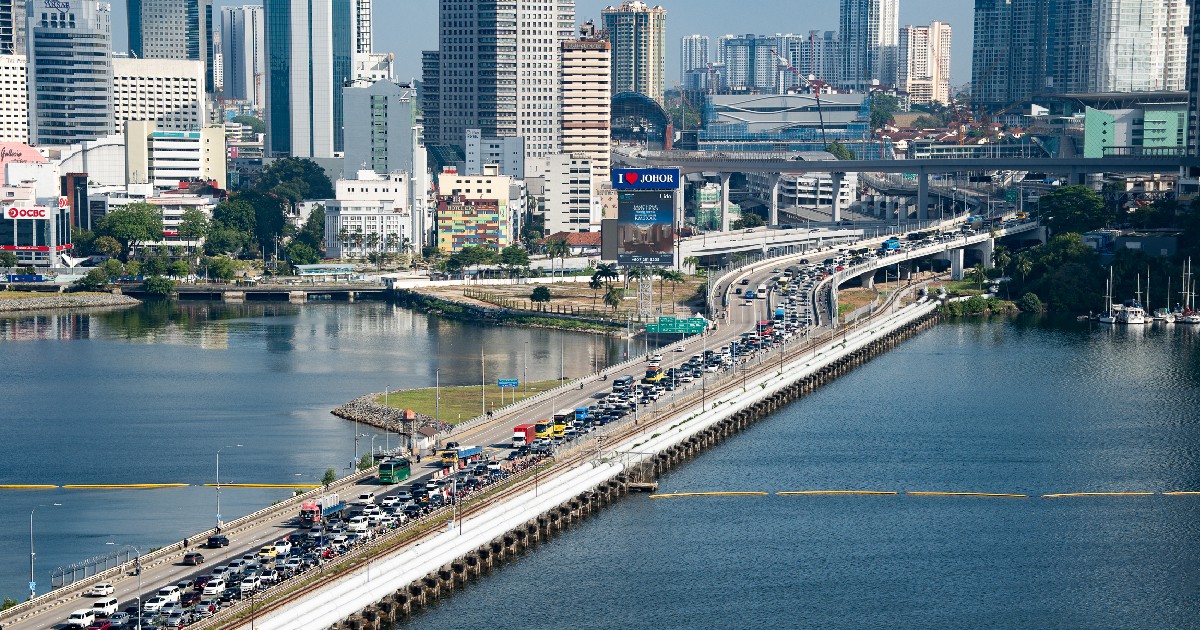
A Five Minute Journey Could Reshape Cross Border Competition
The Johor Bahru-Singapore Rapid Transit System Link is more than another transport infrastructure project. For businesses on both sides of the border, it could significantly change how consumers think about the distance between Singapore and Johor Bahru. The RTS Link will connect Woodlands North in Singapore with Bukit Chagar in Johor Bahru, with the train journey between the two stations expected to take about five minutes. Singapore’s Ministry of Transport has stated that the system will have capacity for up to 10,000 passengers per hour in each direction, with passenger services targeted to begin by the end of 2026. For commuters, this promises a faster and more predictable alternative for crossing the border. For businesses, however, improved connectivity could gradually redraw the competitive landscape.
The impact is particularly important because Singapore and Johor Bahru already have strong economic and consumer connections. Singapore residents regularly travel across the Causeway for shopping, dining, entertainment and services, while Malaysians travel in the opposite direction for employment, business and leisure. The RTS Link does not create this relationship, but it could make participating in it significantly easier. A recent study reported by CNA estimated that Singapore residents could spend about S$1 billion more annually in Johor Bahru after the RTS Link begins operations, with groceries, drug stores and dining expected to attract a significant share of that additional spending. These projections should not be treated as guarantees, but they illustrate why Singapore businesses are paying close attention to the potential changes in consumer behaviour.
For Singapore business owners, especially those operating in retail, food and beverage, beauty, lifestyle and other consumer-facing industries, the question is therefore not simply whether more Singaporeans will visit Johor Bahru. The more important question is how customers will make purchasing decisions when crossing the border becomes easier. A consumer who previously considered travelling to Johor Bahru inconvenient may become more willing to make the journey if transportation becomes faster and more predictable. Price differences that previously did not justify the time and inconvenience of travelling could become more attractive. At the same time, Singapore businesses may gain access to additional Malaysian customers travelling in the opposite direction. The RTS Link therefore represents both competitive pressure and commercial opportunity.
This is why Singapore companies should avoid viewing the RTS Link purely as a transport story. It is ultimately a business story about how lower barriers between two closely connected markets can influence customer behaviour, competition and business strategy. Recent reporting has already highlighted concerns among Singapore merchants about competition from Johor Bahru, while analysts have argued that businesses may need to differentiate themselves through service, convenience, branding and customer experience rather than attempting to compete purely on price. For business owners, the coming change creates an opportunity to reconsider what genuinely makes customers choose them and whether that competitive advantage will remain strong when consumers have more alternatives.
Singapore Businesses Cannot Compete on Price Alone
One of the most obvious challenges created by greater connectivity with Johor Bahru is the difference in operating environments between the two markets. Consumers travelling from Singapore may find certain products, meals and services available at lower prices across the border. This does not automatically mean Singapore businesses will lose customers, but it does make price comparisons easier and potentially more frequent. Retailers and F&B operators may therefore find themselves competing for consumer spending with businesses that are physically located in another country but increasingly feel like part of the same accessible consumer market. Recent Singapore reporting has highlighted exactly this concern, with retailers considering how pricing, product selection and customer experience may need to evolve as the RTS Link approaches.
Trying to respond simply by cutting prices could be difficult. Singapore businesses operate within Singapore’s own cost structure, including wages, commercial rents, utilities, logistics and other operating expenses. A business cannot sustainably reduce prices below the level required to cover its costs simply because a competitor across the border charges less. Aggressive discounting may temporarily protect customer volumes, but it can also reduce margins and create greater financial pressure if the underlying cost structure remains unchanged. Businesses therefore need to understand which customers are genuinely price sensitive and which customers value other factors such as convenience, quality, reliability, speed and service.
Convenience remains a particularly important advantage. Although the train journey itself is expected to take approximately five minutes, travelling between Singapore and Johor Bahru still involves reaching the station and completing the overall cross-border journey. A customer deciding where to have dinner after work, purchase groceries, arrange a service or collect an urgent item will continue weighing time and convenience alongside price. Singapore businesses that provide a seamless customer experience may therefore retain strong competitive advantages even when cheaper alternatives exist nearby.
Quality and trust can also become more important when customers have more choices. Businesses that have developed strong reputations, reliable service standards and meaningful customer relationships give consumers reasons to return that extend beyond price. A restaurant with consistently good service, a retailer with convenient delivery and after-sales support, or a professional service provider that understands its customers deeply may continue to perform well even if lower-cost alternatives are available elsewhere. The RTS Link could therefore encourage businesses to become more deliberate about identifying and strengthening the reasons customers choose them.
There is also evidence that Singapore industry leaders are already encouraging businesses to think along these lines. Recent discussions about the RTS Link have emphasised innovation, partnerships and improved customer experiences as ways businesses can respond to changing cross-border shopping patterns. This suggests that the most sustainable response may not be trying to prevent consumers from travelling to Johor Bahru. Businesses have little control over that decision. Instead, they can concentrate on making their own offerings sufficiently valuable that customers continue choosing them when it makes sense.
For business owners, this requires understanding the economics of their operations. Before adjusting prices or launching promotions, management should understand product margins, operating costs and the financial impact of different strategies. A discount that increases sales may appear successful from a revenue perspective while actually reducing overall profitability if the margin sacrificed on each transaction is too large. Similarly, investing in better service, technology or customer loyalty initiatives requires understanding whether the expected improvement in customer retention justifies the additional expenditure. Accurate financial information becomes particularly valuable when competition changes because businesses need to distinguish between actions that generate genuine value and those that merely create additional activity.
The RTS Link Could Create Opportunities as Well as Competition
It would be a mistake to view greater Singapore-Johor connectivity only as a threat to Singapore businesses. Cross-border infrastructure works in both directions. The same railway that makes Johor Bahru more accessible to Singapore residents also makes Singapore more accessible to Johor residents. Businesses should therefore consider how improved connectivity could expand their potential customer base rather than focusing exclusively on the possibility of spending moving across the border.
Singapore offers its own attractions for Malaysian consumers, including international brands, specialised products and services, entertainment, business activities and experiences that may not be available in exactly the same form in Johor Bahru. Greater transport convenience could make it easier for Malaysian residents to visit Singapore for shopping, dining, entertainment or professional purposes. Businesses located in northern Singapore may be particularly interested in how consumer movement develops once operations begin, although the wider effects could extend beyond Woodlands as the RTS station connects with Singapore’s public transport network. The Woodlands North RTS station is located alongside the Thomson-East Coast Line, providing onward connectivity to other parts of Singapore.
There may also be opportunities that extend beyond consumer spending. Better connectivity can strengthen business relationships between Singapore and Johor, allowing companies to coordinate operations, meet partners and access talent more efficiently. The RTS Link also sits within a broader period of closer economic integration between Singapore and Johor, including the development of the Johor-Singapore Special Economic Zone. Singapore’s Ministry of Transport has specifically noted that the RTS Link will serve the JS-SEZ while strengthening economic and people-to-people ties between the two countries. For businesses, this creates a larger strategic question about how Singapore and Johor may increasingly complement one another rather than functioning simply as competing locations.
A Singapore company might maintain management, finance or customer-facing functions in Singapore while developing partnerships or other operations in Johor where commercially appropriate. Retailers may explore cross-border partnerships. Service businesses could potentially reach customers on both sides. Suppliers may find new markets, while businesses that already operate regionally could benefit from easier movement between two important commercial centres. The possibilities will vary considerably by industry, and not every company needs a cross-border strategy, but the improved connectivity gives business owners another factor to consider when planning future growth.
The key is preparation. Businesses should not wait until the RTS Link begins carrying passengers before considering how customer behaviour or competition could change. They can begin reviewing where customers come from, why those customers choose them, which products generate healthy margins and where the company remains vulnerable to price competition. Management can also consider whether new customer segments, partnerships or cross-border opportunities could become commercially viable as connectivity improves.
This preparation should include financial analysis. Expansion opportunities can look attractive from a revenue perspective while creating additional operating costs, working capital requirements and execution risks. Businesses considering new locations, partnerships, product ranges or marketing strategies should evaluate the financial implications before committing resources. Reliable accounting information allows management to understand existing margins and financial capacity while comparing different scenarios more realistically.
The RTS Link could ultimately make the Singapore-Johor relationship considerably more dynamic. Recent projections about additional Singapore consumer spending in Johor understandably create concerns among some local businesses, particularly in sectors where price differences are highly visible. Yet focusing only on potential losses overlooks the larger transformation taking place. Easier movement creates competition, but it also creates customers, partnerships and new ways of organising business activities.
For Singapore business owners, the strongest response is therefore neither panic nor complacency. It is understanding where their competitive advantage comes from and strengthening it before the market changes. Businesses that rely almost entirely on price may face greater pressure. Those that compete through convenience, quality, service, trust, specialisation or unique customer experiences may find themselves better positioned. Others may discover opportunities to participate directly in the growing economic relationship between Singapore and Johor.
The RTS Link is only infrastructure. What ultimately determines its impact on individual businesses will be how consumers and companies choose to use that infrastructure. As the targeted commencement of passenger services approaches, Singapore businesses have an opportunity to prepare rather than simply react. The companies that understand their customers, know their numbers and remain willing to adapt will be in a stronger position to navigate the new competitive landscape, whether the next customer comes from across the street or across the Johor Strait
The Competitive Impact Will Extend Beyond Retail and F&B
Much of the current discussion surrounding the RTS Link has focused on Singapore’s retailers and food and beverage businesses, and understandably so. These sectors are among the most directly exposed to changes in cross-border consumer spending. A recent study commissioned by the Singapore Business Federation, Restaurant Association of Singapore and Singapore Retailers Association projected that Singapore residents could spend an additional S$1.05 billion annually in Johor Bahru after the RTS Link begins operations. The same study estimated an additional S$756 million of spending by Johor Bahru residents in Singapore, leaving a projected net increase of approximately S$290 million in outbound spending. Groceries, drug stores, dining and beauty services are among the categories expected to experience some of the most significant changes.
However, the longer term economic impact could extend considerably further than restaurants, supermarkets and shopping centres. Easier movement between Singapore and Johor Bahru could gradually influence where businesses locate certain activities, where employees choose to live, how companies organise regional operations and how customers evaluate service providers on either side of the border. The RTS Link is arriving alongside broader efforts to strengthen economic integration between Singapore and Johor, creating an environment in which businesses may increasingly think about the two markets as connected parts of a wider commercial ecosystem rather than entirely separate business environments.
For Singapore companies, this means the RTS Link should not only be considered from the perspective of losing consumer spending to Johor Bahru. Businesses should also consider whether greater cross-border mobility changes their own opportunities. A professional services company may find it easier to work with clients operating in Johor. A Singapore manufacturer could explore partnerships with businesses across the border. Retailers might develop products specifically targeted at Malaysian visitors. Companies operating in both countries may find it easier for management teams to coordinate activities. Even businesses without immediate plans to expand into Malaysia could experience indirect changes through suppliers, employees, customers or competitors.
These developments are particularly important because the RTS Link could reinforce changes that are already occurring. The connection between Singapore and Johor is not suddenly appearing because of a new railway. Singapore residents already travel frequently to Johor Bahru, Malaysian employees already commute into Singapore, and businesses on both sides already maintain extensive commercial relationships. What the RTS Link potentially changes is the amount of friction involved in these interactions. When movement becomes easier and more predictable, activities that were previously possible but inconvenient may become commercially practical.
That distinction matters for business strategy. Competition often changes not because an entirely new competitor appears, but because an existing alternative becomes easier for customers to access. Johor Bahru’s retailers and restaurants have existed for decades. Singapore consumers have been shopping and dining there for years. What changes when transportation improves is the effort required to make that choice. A customer who previously considered travelling across the Causeway worthwhile only for an occasional weekend trip may potentially visit more frequently when the journey becomes easier.
Recent analysis of the RTS Link has therefore highlighted that the impact could extend beyond shops and restaurants, while also creating opportunities for Singapore businesses to reinvent themselves through stronger brands, improved service and new business models. This is an important point for business owners. Infrastructure does not automatically determine which businesses succeed or fail. It changes the environment in which businesses compete. Management still determines how the company responds.
Businesses that understand this distinction can begin asking more useful questions. Which parts of their offering are genuinely differentiated? Which customers are most likely to consider alternatives across the border? Which products are particularly vulnerable to price comparison? Which services benefit from proximity and convenience? Could the company attract customers travelling from Johor Bahru? Are there opportunities to develop partnerships rather than simply viewing Malaysian businesses as competitors?
Answering these questions requires both commercial insight and reliable financial information. A business cannot properly evaluate a new strategy without understanding its current performance. Management needs to know which products generate healthy margins, which locations perform well, which customer segments are most valuable and how much financial capacity is available for investment. As competition becomes more complex, financial information becomes increasingly important because business owners need to determine where resources can generate the greatest return.
Productivity Could Become Singapore’s Most Important Response
If competing purely on price is difficult, productivity becomes increasingly important. Singapore businesses operate within a higher-cost environment, and many are already managing manpower, rental and other operating pressures. The SBF-led study on the RTS Link noted that businesses were already facing manpower constraints, rental costs and operating costs before considering the additional structural competitive pressure created by easier access to Johor Bahru.
This means businesses need to think carefully about how much value they generate from their existing resources. Productivity is sometimes misunderstood as simply asking employees to work faster or reducing headcount. In practice, sustainable productivity improvements usually involve redesigning processes so that employees spend less time on repetitive or low-value activities and more time serving customers, solving problems and generating revenue. Technology, automation, staff training and better management systems can all contribute, but only when they address genuine operational problems.
Consider a restaurant competing with lower-priced dining options in Johor Bahru. The Singapore restaurant may have limited ability to reduce rent or labour costs. However, it can examine table turnover, ordering processes, menu design, food waste, staffing schedules, procurement and customer retention. Improvements across several areas can collectively strengthen margins without requiring the business to simply increase prices. A retailer might examine inventory management, online ordering, delivery, loyalty programmes and the productivity of individual outlets. A service business could automate administrative work and allow employees to spend more time on customer-facing activities.
The objective is not necessarily to become cheaper than businesses across the border. In many sectors that may be unrealistic. The objective is to ensure that Singapore businesses are operating efficiently enough to deliver value customers are willing to pay for.
This distinction becomes especially important when businesses consider discounting as their first response to competition. Reducing prices is easy to implement, but restoring them can be considerably harder. Customers quickly become accustomed to promotional pricing, and competitors may respond with discounts of their own. The result can be a race towards thinner margins where businesses generate similar or even greater revenue while earning less from each transaction.
Before introducing major pricing changes, management should understand the company’s cost structure and contribution margins. A business needs to know how much additional volume would be required to compensate for a lower margin per sale. It should also consider whether operations have enough capacity to handle that additional volume efficiently. A promotion that attracts many new customers can appear successful from the outside while producing disappointing financial results if the underlying economics are weak.
Productivity provides another route. Instead of asking, “How much cheaper do we need to become?” businesses can ask, “How much more value can we create with the resources we already have?”
That value may appear in different forms. Faster service can improve convenience. Better-trained employees can strengthen customer experience. Improved inventory systems can reduce stock shortages. Digital tools can make purchasing easier. Loyalty programmes can encourage repeat business. Better data can help companies understand customer preferences and personalise their offerings. None of these approaches eliminates price competition, but collectively they give customers reasons to choose a Singapore business even when cheaper alternatives exist elsewhere.
The Government has also recognised the concerns of merchants in northern Singapore. A task force has engaged residents, merchants and trade associations about challenges and opportunities related to the RTS Link, with discussions including more tailored business support and infrastructure improvements in the north. This reinforces the broader point that businesses should use the period before full RTS operations to prepare rather than waiting to see what happens.
Cross Border Competition Could Encourage Better Business Models
Greater competition is uncomfortable, but it can also encourage innovation. Businesses operating in relatively stable markets can sometimes continue using the same business model for years because there is little immediate reason to change. A structural shift such as improved cross-border connectivity forces management to reconsider assumptions that previously seemed permanent.
For some Singapore companies, the appropriate response may be strengthening their existing business model. Others may need to change more significantly.
A retailer could reduce dependence on physical store traffic by strengthening e-commerce and delivery. A restaurant could develop membership programmes or exclusive products that encourage repeat visits. A service provider could specialise in areas where expertise and trust matter more than price. Businesses located near transport connections may redesign their offerings for customers travelling between Singapore and Malaysia. Companies with sufficient capabilities could even consider partnerships or expansion opportunities across the border.
The key is avoiding the assumption that every business must respond in exactly the same way.
Different industries have different competitive dynamics. A customer may willingly travel to Johor Bahru to purchase groceries in larger quantities but may still choose a Singapore provider for an urgent service. Someone might cross the border for entertainment on a weekend while continuing to purchase everyday necessities near home because convenience matters more during the working week. Another customer might prefer Singapore for premium products or services where reliability and after-sales support are important.
Businesses therefore need to understand their customers at a more detailed level. Instead of treating everyone as one market, management should identify different customer groups and understand what each group values. Price-sensitive customers may behave differently from convenience-focused customers. Loyal customers may behave differently from occasional visitors. Premium customers may place greater importance on service and quality than price.
The latest analysis of the RTS Link reflects this reality. Businesses and analysts interviewed by CNA have highlighted better service, stronger brands and new business models as potential responses to the changing competitive environment rather than attempting to win solely through lower prices.
This creates an important opportunity for Singapore SMEs. Larger organisations often have more financial resources, but smaller businesses can sometimes adapt more quickly. An SME owner who understands customers closely can introduce a new product, adjust a service process or test a new partnership without navigating the same organisational complexity faced by a large corporation. Agility can therefore become an advantage, provided decisions are supported by sufficient information.
Financial planning remains essential because experimentation still costs money. Businesses considering renovations, new technology, marketing campaigns, additional staff or cross-border expansion need to understand how much they can reasonably invest. Not every idea will succeed, which means companies should maintain sufficient financial resilience to test new strategies without putting their core operations at risk.
The arrival of the RTS Link should therefore encourage businesses to examine not only their competitors but also themselves. Greater connectivity exposes customers to more choices, but it also exposes weaknesses in existing business models. Companies that have relied on location, limited competition or customer habits may need to develop stronger reasons for customers to remain loyal.
At the same time, businesses with strong brands, efficient operations and distinctive offerings could benefit from a larger connected market. The projected increase in spending is not entirely one directional. The same study forecasting S$1.05 billion of additional Singapore resident spending in Johor Bahru also projected S$756 million of additional Johor Bahru resident spending in Singapore. There will therefore be opportunities to capture new inbound demand as well.
The strategic question for Singapore businesses is not simply how much spending will leave Singapore. It is where customers will choose to spend and why.
Companies that can answer that question clearly will be better positioned for the changes ahead. Businesses that understand their margins, improve productivity, strengthen customer relationships and remain willing to adapt may discover that the RTS Link is not simply another competitive threat. It could become a catalyst for building a stronger business model that is capable of competing in a much more connected Singapore-Johor economy.
Singapore Businesses Need to Decide What They Want to Be Known For
As travelling between Singapore and Johor Bahru becomes easier, one of the most important questions for Singapore businesses will be surprisingly simple: why should customers continue choosing them? For years, location and convenience have provided a natural advantage to businesses serving customers who live and work nearby. The RTS Link will not remove that advantage completely, but it could reduce some of the friction that previously discouraged consumers from considering alternatives across the border. Recent analysis has highlighted that the RTS Link could intensify competition for Singapore merchants while also encouraging businesses to reinvent themselves through stronger brands, better service and new business models.
This means businesses need to become more deliberate about their competitive positioning. A company cannot realistically be everything to every customer. Some businesses compete primarily through convenience. Others succeed because of quality, specialist knowledge, customer service, reliability, product selection or a strong brand. Understanding this distinction becomes increasingly important when customers have access to alternatives that may offer substantially lower prices. If a Singapore business cannot explain why customers should choose it despite those alternatives, competing could become considerably more difficult.
Price remains important, but it is only one part of the customer’s decision. Consumers regularly pay more for products and services when they believe the additional value justifies the difference. Someone may choose a nearby restaurant because it saves time after work. Another customer may prefer a Singapore retailer because returns, delivery and after-sales support are easier. A business customer may choose a professional service provider because reliability and expertise matter more than obtaining the lowest possible fee. A premium retailer may attract customers through products or experiences that are difficult to replicate elsewhere.
These differences are where Singapore businesses can build stronger competitive advantages. Rather than immediately asking how to become cheaper, management should consider how to become more valuable to the customers it wants to retain.
The RTS Link may make this exercise increasingly important because cross-border spending is expected to increase significantly. A recent study projected that Singapore residents could spend approximately S$1.05 billion more annually in Johor Bahru after the RTS Link opens, although the actual impact will depend on consumer behaviour once operations begin. For businesses operating in categories such as dining, groceries, beauty, healthcare, retail and lifestyle services, greater accessibility means customers may compare alternatives more frequently.
However, increased comparison does not automatically mean customers will always choose the cheapest option. Businesses should avoid assuming that consumer behaviour is determined by price alone. Different customers have different priorities, and those priorities can change depending on the purchase. A person may travel to Johor Bahru for a weekend shopping trip but still purchase everyday necessities in Singapore. They may seek lower prices for some products while prioritising convenience or trust for others.
This creates an opportunity for businesses to examine their customer base more carefully. Instead of looking only at total sales, management can consider which customers return frequently, which products generate repeat purchases, which services attract loyal customers and where the business generates its strongest margins. This information can help companies decide where to invest.
A business with a particularly strong group of loyal customers might focus on improving membership benefits and customer experience. A company competing in a highly price-sensitive category may need to improve operational efficiency. A specialist provider may strengthen expertise and service quality. A retailer could focus on exclusive products or convenience. There is no universal strategy because the appropriate response depends on what customers value and what the business can deliver profitably.
The important point is that businesses should make these choices deliberately. The RTS Link creates a reason to examine competitive positioning before customer behaviour changes significantly, rather than attempting to respond after sales have already been affected.
Strong Financial Information Will Be Essential When Businesses Adapt
Responding to greater competition often requires investment. Businesses may introduce new technology, redesign stores, improve customer loyalty programmes, train employees, adjust product ranges, strengthen digital channels or invest in marketing. Some companies may explore entirely new business models or cross-border opportunities. These strategies can potentially strengthen competitiveness, but they also require financial resources.
This is where business adaptation becomes a financial management issue as much as a marketing or operational issue.
A business owner may have ten ideas for responding to changing competition but only enough resources to implement two or three properly. Management therefore needs to determine which initiatives deserve investment and which should remain ideas. Reliable financial information helps businesses make these choices because it allows management to evaluate profitability, cash flow, operating costs and available financial capacity before committing resources.
Consider a retailer thinking about renovating an outlet to improve customer experience. The renovation might create a more attractive environment, but management should understand the expected cost and whether the investment is likely to generate sufficient additional sales or customer retention. Another retailer might decide that investing in online ordering and delivery produces a stronger return than improving its physical store.
Similarly, a restaurant may consider expanding its menu to compete with alternatives in Johor Bahru. Adding more dishes could attract customers, but it could also increase ingredient costs, inventory complexity and food waste. Financial information allows management to evaluate the entire impact rather than focusing only on potential additional revenue.
Pricing decisions require the same discipline.
When competition increases, reducing prices can appear to be the fastest solution. However, a lower price does not automatically create a better financial outcome. If a company reduces its margin substantially, it may need a significant increase in sales volume simply to maintain the same overall profitability. If that additional volume also requires more employees, inventory or operating capacity, the financial outcome could become even less attractive.
Business owners therefore need to understand the relationship between pricing, volume and margins before responding aggressively to competitors.
This is particularly important for SMEs because financial resources are usually more limited than those of large corporations. A major company may have sufficient capital to experiment with several initiatives simultaneously. Smaller businesses often need to prioritise carefully. Investing too heavily in an unsuccessful strategy can place significant pressure on working capital.
Accurate accounting information provides a foundation for this prioritisation. Businesses should understand which products and services contribute most strongly to profitability, where costs are increasing and how much cash is available for investment without compromising normal operations. Management can then evaluate strategic responses based on their financial impact rather than following competitors blindly.
The arrival of the RTS Link should therefore encourage businesses to connect competitive strategy with financial planning. Marketing teams may identify opportunities, operations teams may propose efficiency improvements and management may develop expansion plans, but each initiative ultimately needs to make financial sense.
Businesses should also avoid measuring every initiative solely through revenue. An increase in sales can look impressive while producing little improvement in profitability if the cost of generating those sales is too high. Similarly, a strategy that produces modest revenue growth but significantly improves margins or customer retention could create greater long-term value.
This is why adapting successfully requires businesses to know their numbers as well as their customers.
Conclusion
The Johor Bahru-Singapore RTS Link has the potential to become one of the most significant changes to the economic relationship between Singapore and Johor in recent years. By making cross-border travel faster and more predictable, it could influence where people shop, dine, work, obtain services and spend their leisure time. Singapore merchants are already considering what easier access to Johor Bahru could mean for competition, particularly as research suggests that additional consumer spending could flow across the border once the connection becomes operational.
Yet viewing the RTS Link only as a threat would overlook half of the story.
Greater connectivity works in both directions. Singapore residents will gain easier access to Johor Bahru, but Johor residents will also gain easier access to Singapore. Businesses may discover new customers, partnerships and operational possibilities as movement between the two markets becomes more convenient. The wider Singapore-Johor economic relationship could become increasingly important as infrastructure and economic initiatives strengthen connections between both sides.
The RTS Link itself is designed for substantial cross-border movement, with capacity for up to 10,000 passengers per hour in each direction. Changes on this scale can influence more than transportation. Over time, they can influence consumer behaviour, labour mobility, investment decisions and the way businesses think about their addressable markets.
For Singapore businesses, the appropriate response is preparation rather than panic.
Companies should understand why customers choose them and identify where they remain vulnerable to competition. Businesses that depend primarily on price may need to strengthen productivity and efficiency. Companies with strong customer relationships can invest further in service and loyalty. Retailers can examine product differentiation and convenience. Service providers can strengthen expertise and trust. Some organisations may find opportunities to expand their customer base or develop partnerships across the border.
Most importantly, businesses need to understand whether these strategies make financial sense.
Changing a business model because competitors are changing is not automatically a good strategy. Every investment needs to be evaluated against the company’s financial capacity, customer demand and long-term objectives. Businesses that maintain accurate accounting information and regularly review their performance will be better positioned to make these decisions because management can distinguish between strategies that create genuine value and those that simply generate additional activity.
The competitive environment may also evolve gradually rather than changing overnight. Consumer habits take time to develop. Some Singapore residents may use the RTS Link frequently, while others may continue travelling to Johor Bahru only occasionally. Different industries will experience different effects, and businesses located in different parts of Singapore may see different patterns.
This uncertainty makes flexibility valuable.
Instead of committing immediately to dramatic changes, businesses can monitor customer behaviour, experiment with new offerings and adjust strategies as clearer patterns emerge. Management can track customer traffic, transaction values, margins and other relevant indicators to understand whether competitive conditions are actually changing for their particular business.
Singapore companies should also recognise that competition with Johor Bahru is part of a larger regional trend. Southeast Asian economies are becoming increasingly connected, and consumers have more choices than ever. Technology already allows customers to compare prices internationally, purchase products from overseas and access services remotely. Improved physical connectivity simply adds another dimension to this broader transformation.