
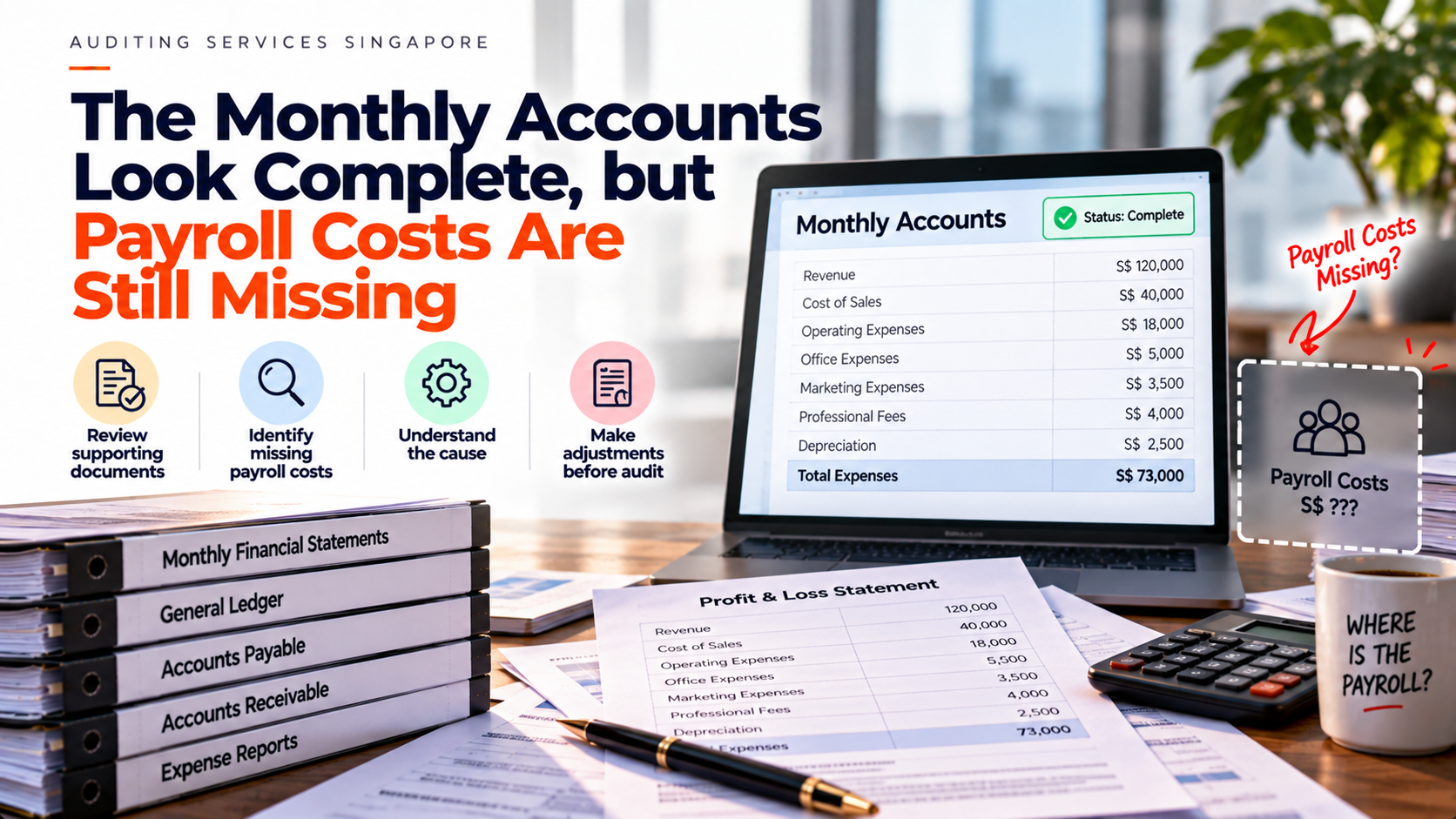
The monthly accounts arrive on schedule. Sales have increased, operating expenses appear controlled, and the business reports a stronger profit than expected. Management begins discussing additional hiring or a new project, confident that the figures show room for expansion.
A week later, finance receives overtime records that missed the payroll cut-off. A department manager also confirms an outstanding staff incentive, while HR identifies a salary adjustment that has not reached the accounts. The report was complete in appearance, but it did not include all the costs associated with the month’s activity.
Credon PAC provides accounting, bookkeeping, financial reporting and payroll services. For businesses relying on monthly accounts, connecting these functions helps ensure that staff costs are supported by more than the latest payment run. The objective is to understand what employees have earned, what remains payable and which reporting period the amounts relate to.
A Completed Payroll Run Does Not Close the Accounting Period
Payroll processing and financial reporting follow related but different timetables. Payroll may need to close several days before month-end so that salaries can be checked and paid. The accounting period may continue beyond that operational deadline.
This creates a gap when employees work overtime, earn allowances or receive adjustments after the payroll submission date. Those amounts may enter the next payment run even though they relate to services provided earlier.
Under employee benefit accounting principles, recognition generally follows employee service and the resulting obligation, rather than the bank payment date alone. Depending on the nature of the work and applicable requirements, staff costs may be recognised as expenses or included in the cost of an asset.
Finance therefore needs a separate month-end review. Confirmation that payroll has been processed establishes that a payment cycle is complete. It does not establish that every relevant employee cost has reached the ledger.
Find Out Which Information Arrives Late
Start by identifying the payroll inputs that regularly arrive after the reporting deadline. Overtime sheets, shift allowances, approved salary revisions and incentive calculations are common areas to examine.
The issue may arise because operational managers approve information at different times. One department submits final records promptly, while another waits until the next payroll run. Finance may receive a complete payroll report without knowing which departments still have outstanding items.
Create a clear record of the information needed from each responsible person. The submission should distinguish confirmed amounts, estimates requiring review and items still under investigation.
This makes missing information visible before management receives the accounts. It also helps identify whether the problem is an occasional delay or a recurring weakness in the handover between operations, HR and finance.
Measure the Effect on Reported Profit
Missing staff costs can change how management interprets a month’s performance. The effect is particularly important when profit margins are narrow or directors are comparing results against a target.
Consider a hypothetical service business reporting monthly profit of S$45,000. A subsequent review identifies S$12,000 of overtime earned during the month and S$3,000 of related employer costs that should also have been recorded. Assume these amounts are properly supported and are expenses of that period.
After the S$15,000 adjustment, profit becomes S$30,000. The original report overstated profit by half of the corrected amount, even though the missing costs represented a relatively small proportion of total revenue.
The example shows why management should consider the reporting effect rather than dismiss an item as “only a payroll adjustment.” Several individually modest omissions can materially change the conclusion drawn from the accounts.
Use Supported Estimates Where Final Figures Are Pending
A month-end close does not always need to wait for every final payroll calculation. Where an obligation exists and an appropriate estimate can be made, finance can assess the necessary accrual using available evidence.
Supporting information might include hours worked, applicable pay terms and confirmation from the responsible manager. The estimate should explain the period covered, the calculation and any uncertainty.
An arbitrary percentage of the previous month’s payroll is less useful when working patterns have changed substantially. A business running a major event or completing a demanding project may have very different overtime costs from its normal operations.
The estimate should be reviewed against the final amount once it becomes available. Differences provide useful feedback about the process. Repeated large adjustments suggest that the original evidence or calculation method needs improvement.
Review Bonuses According to the Actual Obligation
Bonuses require a more specific assessment than simply dividing an annual budget by twelve. Management needs to consider the plan terms, employee service, relevant conditions and whether an obligation has arisen.
Under IAS 19, the expected cost of profit-sharing and bonus arrangements is recognised when there is a legal or constructive obligation arising from past events and the amount can be estimated reliably. A constructive obligation can arise from established practice where the entity has no realistic alternative to payment.
A budgeted amount alone does not establish that conclusion. Equally, describing a payment as discretionary does not remove the need to examine the actual circumstances.
Finance should obtain the relevant policies and management decisions before determining the treatment. Any monthly estimate should have a documented basis and be updated when performance, eligibility or other relevant assumptions change. The purpose is to reflect the obligation, rather than smooth profit across the year.
Reconcile Payroll Costs With Payments and Liabilities
The amount transferred to employees is not necessarily the full staff cost for the period. Net salary payments reflect deductions, while employer contributions and other payroll-related amounts may be recorded or paid separately.
Finance should reconcile the payroll report to the general ledger and the relevant liability accounts. The reconciliation needs to explain gross remuneration, deductions, employer costs, amounts paid and balances outstanding.
Employee deductions should not be added again as a separate employer expense merely because they are remitted through another payment. Clear account mapping helps prevent this type of duplication.
The review should also identify unexplained balances carried forward. An old payroll payable may represent an unpaid amount, an allocation error or an entry that was never cleared. Its presence needs an explanation rather than an assumption that it belongs to the next payment cycle.
Make Sure Accruals Clear When Payroll Is Processed
Recording an accrual solves only part of the problem. The business also needs a process for clearing or reversing it when the actual payroll entry is recorded.
Without that connection, the same cost can appear twice. Alternatively, an accrual may be reversed automatically even though the amount remains unpaid and has not yet been recorded through payroll.
Maintain a schedule showing the opening balance, new accruals, amounts settled or replaced by actual entries, and the closing balance. Each significant item should have a description and reporting period.
For example, an overtime accrual for September should be matched to the relevant October payroll processing. If the final figure differs, finance should explain the adjustment. A clear schedule prevents estimates from becoming permanent balances that nobody can trace.
Check Where Staff Costs Have Been Allocated
Completeness is not only about the total payroll expense. Staff costs may be recorded in the wrong department, project or entity, creating misleading performance reports even when the company-wide amount is correct.
Employees can move between branches, support several projects or work temporarily for another group company. Payroll records may continue using the original allocation unless someone communicates the change.
Review significant movements with operational managers and use a supportable basis for shared costs. Time records or other appropriate evidence may be relevant, depending on the work and the reporting purpose.
Credon’s management accounts and financial reporting support can help businesses organise the financial information used in these reviews. Operational teams still need to provide accurate details about where work was performed so that the accounting records reflect the activity being assessed.
Keep Cash Forecasts Separate but Connected
Recording unpaid staff costs reduces reported profit where an expense is recognised, but it does not necessarily reduce the bank balance immediately. Management needs to understand both the accounting effect and the future payment requirement.
The cash forecast should include the expected settlement of payroll liabilities alongside regular salaries and other commitments. An accrued bonus or delayed overtime payment can create a larger cash requirement in a later month.
This connection is useful when management interprets a temporarily strong bank balance. Cash remaining in the account may already be needed to settle employee obligations.
The forecast and ledger should therefore use consistent information while serving different purposes. The accounts explain the recorded costs and liabilities. The cash forecast explains when the business expects to fund the payments.
Give HR, Operations and Finance Clear Responsibilities
Payroll information often passes through several teams. Operations confirms work performed, HR maintains employment terms, payroll calculates payments, and finance prepares the accounts. Missing costs can arise when each team assumes another has completed the review.
Define who confirms outstanding overtime, communicates remuneration changes and identifies incentive obligations. Establish who reviews the resulting accrual and who approves the accounting entry.
The process should include an explicit response where there are no outstanding items. Silence is difficult to distinguish from a missed request, especially during a busy close.
Sensitive payroll information should remain available only to the people who need it. Finance can use appropriately controlled summaries for reporting purposes while retaining sufficient supporting detail for authorised review. A well-designed handover improves completeness without circulating personal information unnecessarily.
Make Outstanding Items Visible Before Reports Are Issued
If important payroll information remains unresolved, management should understand the limitation before relying on the monthly results. A report labelled final should not conceal significant outstanding inputs.
The close process can include a short status review identifying missing submissions, material estimates and items awaiting a decision. Finance should assess whether the information available supports issuing the report or whether further work is needed.
Where management receives preliminary figures, explain what remains open and the potential effect where it can be reasonably estimated. Keep track of subsequent revisions so that decisions are based on the latest approved version.
This is more useful than repeatedly changing the accounts without explanation. Directors should be able to understand whether a movement reflects business performance, an updated estimate or information that arrived late.
Use Variance Analysis to Identify Missing Costs
A comparison with prior periods and budgets can help direct attention to unusual payroll movements. A busy month with significantly lower overtime costs may deserve investigation, particularly if staffing levels and working patterns suggest otherwise.
The analysis should consider operational context. A fall in costs could be entirely reasonable because a project ended, employees left or workloads reduced. The purpose is to identify questions, not assume every favourable variance is an error.
Compare the explanation with supporting records. If a manager reports extensive weekend work but the accounts show no related cost, finance should establish whether the amount is included elsewhere, pending or omitted.
Over time, this review can reveal recurring submission problems. Correcting the underlying process is more effective than relying on the same late adjustment every month.
Build Monthly Reports on Complete Staff Cost Information
Reliable monthly reporting depends on the information behind the figures. A payroll file can be accurate for its payment cycle while the accounts still omit costs relating to the wider reporting period.
The practical response is to connect service dates, employment terms, estimates and final payments. Reconciliations should explain both the expense and the outstanding liability, while review procedures should identify missing information before management relies on the results.
Credon PAC offers payroll, bookkeeping and financial reporting services that businesses can discuss when reviewing these connections. The scope should reflect the company’s processes and identify who is responsible for supplying, approving and recording each category of information.
A useful starting point is the next month-end close. Confirm the outstanding payroll inputs, review supported accruals and reconcile earlier estimates to actual processing. With those steps in place, management has a clearer basis for assessing profit, planning payments and making decisions about the business.