
The Sales Team Is Celebrating, but Finance Is Asking a Different Question
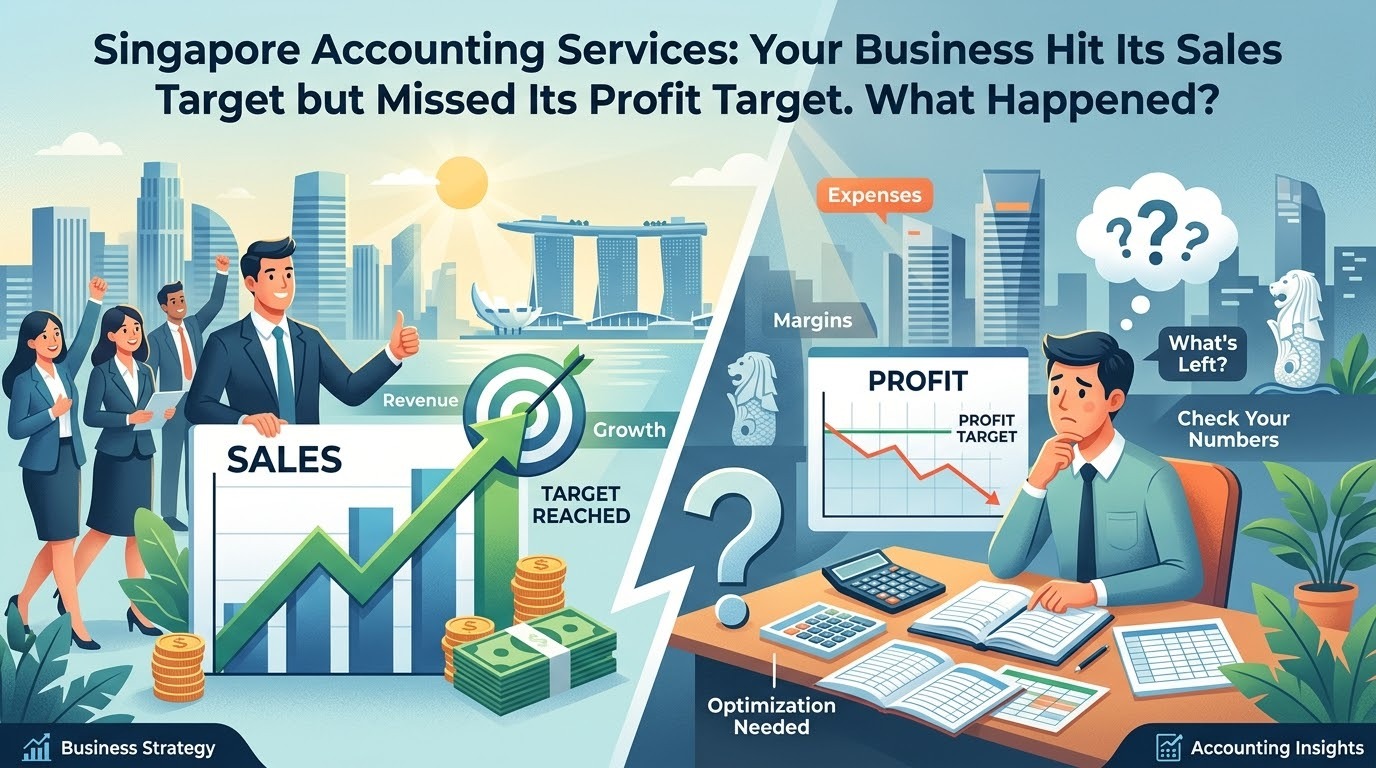
The company set an ambitious sales target at the beginning of the year: S$10 million in revenue. Twelve months later, the sales team has delivered. New customers were acquired, existing accounts increased their orders and the final revenue figure even came slightly above target at S$10.2 million. From a sales perspective, the year looks successful. Yet when management reviews the financial results, the celebration becomes more complicated. The company expected to earn S$1.5 million in profit but generated only S$850,000. Revenue reached its target, customers continued buying and employees worked harder than ever, so where did the expected S$650,000 go? This is one of the situations where businesses begin to understand why Singapore accounting services should provide more than transaction recording. Revenue tells management how much the company sold. It does not tell management how efficiently those sales were converted into profit, and a business can achieve an impressive sales target while simultaneously allowing its economics to deteriorate.
Hitting the Sales Target Does Not Automatically Mean the Business Performed Well
Sales targets are attractive because they are simple to understand. If the target is S$10 million and the company sells S$10.2 million, performance appears to be 102% of target. But revenue is only the beginning of the financial story. The company still needs to pay for products, employees, premises, technology, logistics, marketing, financing and numerous other expenses required to generate those sales. Two companies can each produce S$10 million in revenue while one earns S$2 million and the other earns S$500,000. Even within the same company, S$10 million of revenue this year may be substantially less valuable than S$10 million last year if costs, discounts or the mix of products have changed. This is why management should avoid treating revenue growth as a complete measure of business success. Sales matter enormously, but profitable sales matter more.
The Missing Profit May Not Be Hiding in One Large Expense
When management discovers a S$650,000 profit shortfall, the first instinct may be to search for one major unexpected cost. Perhaps a machine broke, an important project exceeded budget or the company suffered a significant bad debt. Sometimes there is indeed a large explanation, but profit deterioration often occurs through dozens of smaller movements. Supplier costs rise S$120,000, payroll exceeds budget by S$150,000, sales discounts reduce revenue quality by S$100,000, delivery expenses add S$60,000, overtime contributes another S$50,000 and various software, professional, repair and administrative costs consume the remainder. None of these items individually appears capable of ruining the year. Together, they can erase a substantial portion of expected profit. Good financial reporting should therefore help management build a bridge between expected and actual profit instead of merely confirming that the target was missed.
Gross Margin Is Often the First Place Management Should Look
If sales achieved target but profit did not, gross margin is an important starting point. Suppose the company budgeted S$10 million of revenue with a 40% gross margin, meaning it expected approximately S$4 million after the direct costs associated with those sales. Revenue ultimately reached S$10.2 million, but gross margin fell to 34%. Instead of producing more than S$4 million of gross profit, the business generated only around S$3.47 million. Before management even considers salaries, rent, marketing and administrative expenditure, more than half a million dollars of expected economic value has already disappeared. This is why a sales report alone can create false confidence. The business may be selling the right amount while earning too little on each dollar of sales.
Supplier Prices May Have Increased Without Selling Prices Following Them
One common reason for declining gross margin is a change in input costs. Suppliers may increase prices for materials, products, subcontracting, freight or other components required to serve customers. If the company continues charging customers the same price, it absorbs the difference. Imagine a product that sells for S$100 and previously cost S$60 to provide, creating S$40 of gross profit. If the cost rises to S$68 while the selling price remains S$100, gross profit falls to S$32. The sales team can sell exactly the same number of units and report exactly the same revenue, yet gross profit has declined by 20%. If this happens across thousands of transactions, the impact becomes substantial. Management therefore needs regular visibility into margin rather than waiting until year-end to discover that supplier increases have quietly been funded by the company’s profit.
Sales Discounts Can Help Revenue While Hurting Profit
Another possibility is that the company reached its sales target partly by offering more discounts. Perhaps customers were hesitant, competitors became aggressive or the sales team was under pressure to achieve its annual number. A salesperson who reduces a S$100 price to S$90 may view the decision as sacrificing 10% of revenue to secure the sale. The effect on profit can be considerably larger. If the product costs S$70 to provide, selling at S$100 produces S$30 of gross profit, while selling at S$90 produces only S$20. A 10% discount has therefore reduced gross profit on that sale by one-third. Discounts can be commercially sensible, especially when they secure strategic customers or larger volumes, but management needs to understand their economics. A company should not celebrate achieving S$10 million of sales without asking what concessions were required to reach the number.
Salespeople May Be Rewarded for Revenue Rather Than Profitable Revenue
Incentives influence behaviour. If sales employees receive bonuses primarily for achieving revenue targets, they naturally focus on closing sales. They may favour large contracts even when margins are thin, offer discounts to remove customer hesitation or accept demanding commercial terms because those decisions help them reach their targets. From the salesperson’s perspective, this can be entirely rational because the incentive system rewards revenue. Finance may later discover that the company sold more but earned less. Businesses should therefore examine whether their performance measures encourage the outcomes management actually wants. Revenue remains an important metric, but organisations may also need visibility into gross margin, customer profitability, collections or other measures appropriate to their business model. The objective is not to turn salespeople into accountants. It is to ensure commercial success and financial success are not being measured as if they were unrelated.
Product Mix Can Change Profit Even When Total Revenue Looks Perfect
Imagine a company sells two product categories. Product A generates a 50% gross margin, while Product B generates 20%. Management prepares its annual budget assuming S$6 million of Product A and S$4 million of Product B, producing a particular expected margin. During the year, customer demand changes. Product A produces only S$4 million while Product B reaches S$6 million. Total revenue is still S$10 million, so the sales target has technically been achieved. The economics, however, are very different because more revenue came from the lower-margin product. This is known as a change in sales mix, and it can explain why businesses miss profit targets despite delivering expected revenue. Management should therefore examine not only how much was sold but what was sold and at what margin.
Customer Mix Can Be Just as Important as Product Mix
The same product can generate different levels of profitability depending on the customer. One customer may purchase S$500,000 annually at standard pricing, order predictable quantities, pay within 30 days and require minimal support. Another may purchase the same S$500,000 but negotiate significant discounts, demand urgent deliveries, request customised reporting, return products frequently and pay after 90 days. Both appear identical on a revenue ranking because each contributes S$500,000 of sales. They may be completely different from a profitability perspective. If growth comes primarily from customers who are expensive to serve, the company can reach its sales target while generating less profit than expected. Management therefore benefits from looking beyond headline customer revenue and considering the actual economics of important relationships.
Delivery and Fulfilment Costs Can Turn a Good Sale Into a Weak One
Sales teams understandably focus on winning orders, but the cost of fulfilling those orders can determine whether they ultimately create value. A large customer may demand urgent shipments, smaller delivery batches, special packaging, weekend work or additional quality checks. These requirements can increase logistics and operational expenses substantially. If those costs are not incorporated into pricing or monitored properly, revenue appears healthy while profit deteriorates elsewhere in the accounts. This is particularly important when businesses introduce free delivery or premium service as a competitive advantage. “Free” is free only to the customer. Somebody inside the business still pays for the vehicles, fuel, third-party logistics, employee time and operational complexity required to provide it.
Overtime Can Be the Hidden Cost of Successful Sales
A strong sales year can create operational pressure. More orders require more production, fulfilment, customer support and administrative work. If the business does not have sufficient capacity, employees may work overtime to meet demand. From a commercial perspective, the company appears successful because orders are increasing. Financially, however, the additional revenue may carry unexpected labour costs. Suppose the sales team wins an additional S$500,000 of business, but operations requires S$100,000 of overtime and temporary labour to fulfil it. The incremental profit from those sales may be far lower than management expected. This does not necessarily mean the business should reject the revenue. It means management needs to understand the full cost of delivering growth and determine whether capacity, pricing or processes should change.
Payroll Can Rise Faster Than Revenue Without Management Noticing Immediately
Employee costs are often one of the largest expenses for service-oriented businesses. During a year of growth, departments may hire additional employees, award salary adjustments, pay bonuses or increase allowances. Each decision can be reasonable in isolation. The problem appears when total payroll grows significantly faster than the revenue or productivity it supports. If revenue increases 5% while employee costs increase 15%, the business needs to understand whether it is deliberately investing ahead of future growth or simply becoming less efficient. Management should not automatically conclude that payroll is too high, because new employees may be building capabilities that will generate value later. However, the relationship between payroll, output and profitability deserves regular attention rather than being examined only when annual profit disappoints.
Marketing Can Generate Sales Without Generating Enough Profit
Marketing expenditure presents another interesting challenge. A campaign may successfully produce S$1 million of additional revenue, making the campaign look highly effective. But management also needs to understand the margin on those sales, campaign expenditure, promotional discounts and the cost of serving newly acquired customers. If S$1 million of additional revenue generates S$250,000 of gross profit while marketing and promotional costs total S$220,000, the commercial impact looks very different from the headline sales figure. This does not mean marketing should be evaluated purely on immediate profit because brand building and customer acquisition can create long-term value. It does mean businesses need appropriate financial information to distinguish between growth that creates value and growth that merely increases activity.
Bad Debts Can Turn Recorded Sales Into Money the Business Never Receives
A company can record revenue when the relevant accounting criteria are met, but that does not guarantee the customer will eventually pay. If sales growth is accompanied by looser credit standards, overdue receivables can accumulate. The sales team may report excellent results while finance is increasingly concerned about customers who have not paid for 60, 90 or 120 days. Eventually, some amounts may become doubtful or irrecoverable, reducing the economic value of the original sales. This is why revenue growth should be reviewed alongside accounts receivable ageing and customer payment behaviour. A S$500,000 sale that takes an exceptionally long time to collect or is ultimately not collected cannot be evaluated in the same way as a S$500,000 sale that converts reliably into cash.
More Revenue Can Require More Working Capital
Even when every customer eventually pays, rapid sales growth can consume cash and create additional financing costs. A company may need to purchase inventory, pay suppliers and cover employee costs weeks or months before receiving customer payments. If revenue expands quickly, the amount tied up in receivables and inventory can also expand. The business may then require an overdraft or other financing to support growth. Interest expense increases, further reducing profit. Management can therefore achieve its sales target while simultaneously creating additional financial pressure. This is another reason accounting should connect the profit and loss statement with the balance sheet and cash-flow position rather than analysing revenue in isolation.
Fixed Costs Do Not Always Stay Fixed
Management budgets often classify expenses such as rent, technology, administration and management salaries as relatively fixed. Yet these costs can increase as the company grows. A larger team may require more office space, additional software licences, more equipment, greater insurance coverage and additional administrative support. A company may also invest in new systems because existing processes cannot handle increased transaction volumes. These expenses may be strategically necessary, but they change the amount of profit generated from additional revenue. Management should therefore review whether the cost base has expanded according to plan. If the business added S$2 million of revenue but also added S$1.8 million of costs, the growth may be far less valuable than the sales headline suggests.
Small Expenses Can Become Significant When the Business Gets Larger
Growing companies frequently accumulate small recurring expenses because individual purchases receive little attention. A department adds a S$500 monthly subscription, another adds S$1,000, a manager approves a new service contract and employees begin using additional platforms. None seems material relative to a company generating millions of dollars of revenue. Multiply those decisions across departments and twelve months, however, and the total can become substantial. The same applies to travel, entertainment, repairs, bank charges, professional fees and miscellaneous purchases. The objective is not to create bureaucracy around every small expense. It is to recognise that cost discipline becomes more important, not less important, as organisations grow. A company can miss its profit target through hundreds of reasonable expenditures that nobody considered collectively.
Budget Versus Actual Analysis Should Explain the S$650,000 Gap
Returning to the example of the company that expected S$1.5 million of profit but earned S$850,000, management should not accept “costs were higher” as a sufficient explanation. Finance should help break down the difference. Perhaps lower gross margin explains S$300,000, additional payroll S$150,000, logistics S$70,000, bad debts S$50,000, technology S$30,000 and various other expenses S$50,000. The exact categories will differ between businesses, but the principle is important. Management should be able to understand the major drivers of the variance. Once the S$650,000 gap is separated into components, the company can determine which issues require action and which represent deliberate investments or unavoidable circumstances.
Monthly Accounts Can Identify the Problem Before December
If management discovers the entire profit shortfall only after year-end, many opportunities to respond have already disappeared. Suppose gross margin began falling in March. Monthly management accounts could have revealed the trend in April or May, allowing the company to review supplier prices, customer pricing and discounts. If overtime began increasing in June, management could investigate capacity before the cost continued for another six months. If receivables started deteriorating in August, credit control could respond before year-end. Timely accounting information turns financial reporting into an early-warning system. The objective is not merely to tell management that the company missed its profit target. It is to identify the factors causing the miss while management still has time to influence the outcome.
The Profit and Loss Statement Is the Beginning of the Investigation
A profit and loss statement can show that revenue reached target, cost of sales increased and operating expenses exceeded budget. Management then needs to investigate the reasons behind those movements. Which supplier costs changed? Which products experienced lower margins? Which customers received larger discounts? Which departments increased payroll? Which expenses were exceptional and which are likely to continue next year? A useful financial review therefore combines accounting data with operational knowledge. Finance may identify where the variance occurred, while sales, operations and management help explain why it occurred. This collaboration is important because accounting numbers describe the financial effect of business decisions, but the explanation often sits within the activities that produced those numbers.
Singapore Accounting Services Should Help Businesses See More Than Revenue
For businesses considering Singapore accounting services, the value of professional accounting support should extend beyond recording invoices and preparing year-end figures. Regular bookkeeping, reconciliations, management accounts and financial reporting can provide the foundation management needs to monitor margins, expenses, receivables and other financial trends. Credon Public Accounting Corporation provides accounting and related professional services to businesses in Singapore. Reliable financial records can help management move beyond asking whether sales increased and towards understanding whether those sales are creating the expected financial return. The accountant does not replace management’s commercial judgement, but better financial visibility allows that judgement to be based on more than the sales number alone.
Sales and Finance Should Not Be Celebrating Different Versions of Success
A healthy organisation should not have a sales department celebrating S$10.2 million of revenue while finance quietly worries about collapsing margins. Both teams are looking at legitimate parts of the business, but management needs them to work towards compatible objectives. Sales should understand enough about margins and commercial terms to recognise that not every dollar of revenue creates equal value. Finance should understand enough about customers and market conditions to recognise that maximising margin on every individual transaction may not be commercially realistic. The objective is not for finance to control sales or for sales to ignore financial discipline. It is for both functions to understand what profitable growth looks like.
Next Year’s Sales Target Should Not Be Set Without a Profit Conversation
If management responds to this year’s S$10.2 million revenue by setting next year’s sales target at S$12 million without addressing the S$650,000 profit shortfall, the company risks scaling the same problem. More sales at deteriorating margins can produce more operational pressure without delivering the expected financial return. Before setting the next target, management should understand which products, customers and channels generated attractive margins, where costs exceeded expectations and what changes are required. The company may still pursue aggressive revenue growth, but the growth plan should include assumptions about pricing, gross margin, staffing, operating costs and working capital. Sales targets become much more meaningful when they are connected to the financial outcome the company is trying to achieve.
Sometimes the Right Decision Is to Walk Away From Revenue
Businesses naturally dislike losing customers or rejecting orders, but some revenue can become economically unattractive. A customer demanding increasingly large discounts, extended payment terms, custom work and expensive support may eventually contribute too little profit to justify the resources required. A product may remain popular while rising costs make its margin unsustainable. Management should first consider repricing, redesigning the service or improving efficiency, but there are situations where declining unprofitable business is healthier than preserving revenue at any cost. This can feel uncomfortable because sales may fall, yet profit and capacity can improve. A smaller amount of high-quality revenue can sometimes create a stronger business than a larger amount of low-margin activity.
Profit Targets Need to Be Managed Throughout the Year
Revenue receives constant attention because sales figures are usually visible and easy to track. A salesperson knows how much has been sold this week and management may review the pipeline every month. Profit, however, can receive much less attention until financial reports arrive. Businesses should consider whether their management rhythm gives profitability sufficient visibility. Depending on the organisation, this may involve reviewing gross margin, operating expenses, customer profitability, budget variances and receivables alongside sales performance. The appropriate measures will vary, but the principle is consistent: if profit matters only during year-end reporting, management should not be surprised when the annual result differs significantly from the target.
A Missed Profit Target Can Be More Useful Than a Perfect Year
Missing a profit target is disappointing, but it can also reveal weaknesses that would otherwise remain hidden. Perhaps the company learns that sales incentives encourage excessive discounting, product profitability is not being monitored, supplier increases are not reflected in prices or rapid growth is creating too much overtime. These findings can improve future decision-making if management investigates them properly. The worst response is to treat the S$650,000 shortfall as simply an unfortunate year and immediately set another revenue target. The more useful response is to understand exactly what changed and whether the causes are temporary, structural or within management’s control.
Conclusion: Revenue Tells You How Much You Sold, Not How Successful the Year Was
A business that hits its sales target has achieved something important. Customers chose to buy, employees delivered the work and the commercial team generated the expected level of activity. But revenue alone cannot determine whether the business had a successful year. Supplier increases, discounts, product mix, customer profitability, overtime, payroll, bad debts, financing costs and operating expenses all influence how much of that revenue ultimately becomes profit. When a company achieves S$10.2 million of sales but earns S$650,000 less profit than expected, management should not simply ask finance why expenses were high. It should examine the entire path from the first dollar of revenue to the final dollar of profit.
The Better Question Is Not “Did We Hit the Sales Target?”
The better question is “Did the sales we generated create the financial result we expected?” That small change in perspective can significantly improve how management evaluates growth. A company can sell more while becoming less profitable, and it can sometimes sell less while improving margins and cash generation. Strong financial management therefore requires sales information and accounting information to tell one coherent story. This is where reliable Singapore accounting services can support better business decisions: not by replacing the judgement of owners and managers, but by giving them the financial visibility to understand what their commercial success is actually worth. The goal should never be revenue for the sake of revenue. The goal is sustainable, profitable growth that strengthens the business rather than simply making the sales number bigger.