
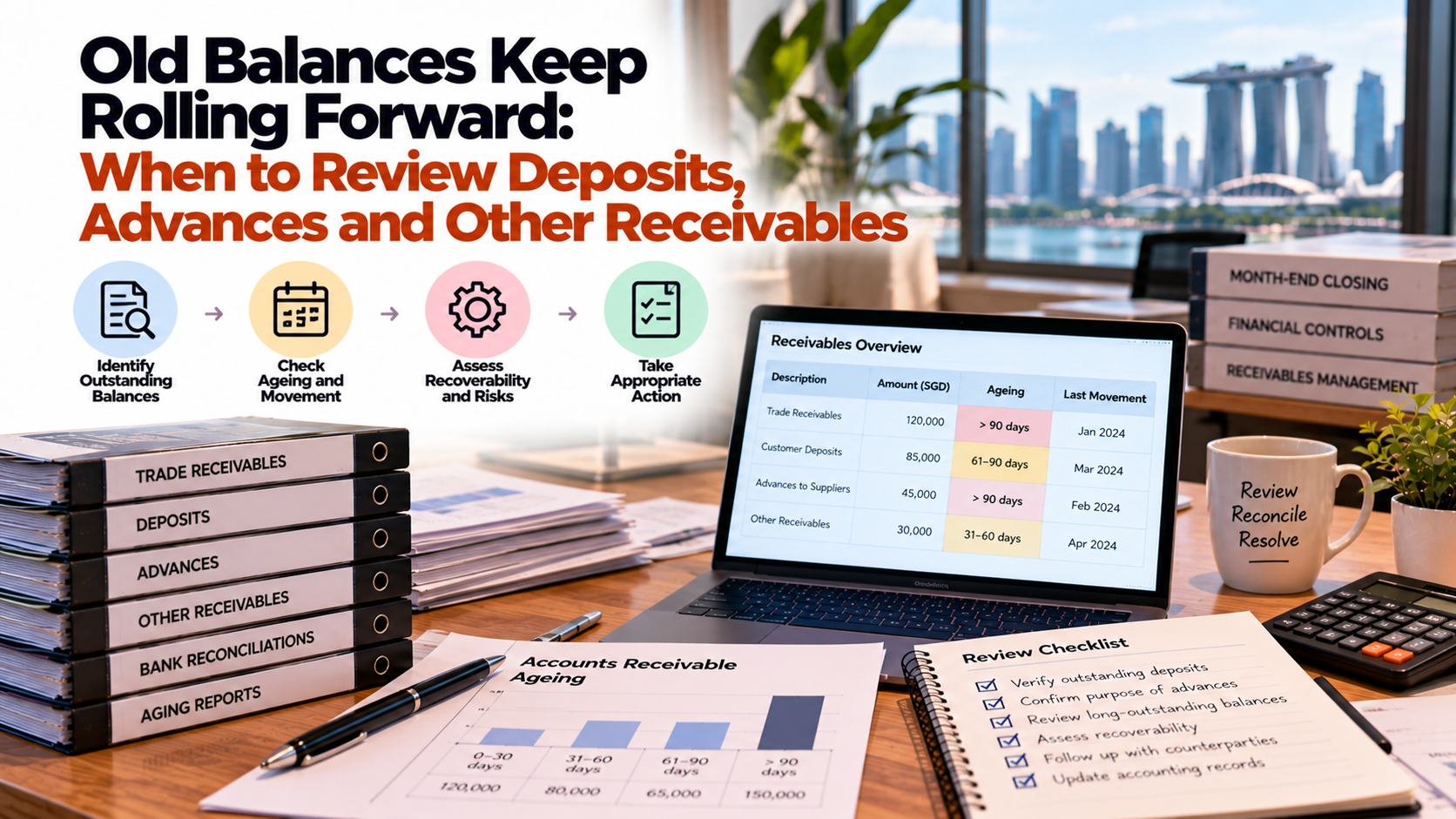
The monthly accounts contain a familiar list of balances: a deposit for premises the business no longer occupies, an advance to a supplier whose project has stalled, and several amounts described simply as “other receivables”. They have appeared in the reports for so long that nobody questions them during the usual review.
Some may remain valid assets. Others may have been refunded without the receipt being matched, consumed through services already delivered or left unresolved after an employee departed. Carrying a balance forward confirms only that it remains in the ledger. It does not establish what the company is still entitled to receive.
Credon provides audit, financial reporting and advisory services. For businesses seeking clearer accounts, reviewing older balances is a practical way to connect recorded assets with current evidence. The objective is to establish what each amount represents, whether its treatment remains appropriate and what action is needed to resolve it.
Begin With the Nature of the Balance
Deposits, advances and other receivables are often grouped together in management reports, but they can represent different rights. A refundable rental deposit may involve a future cash repayment. A supplier advance may entitle the business to goods or services. A staff advance may require an expense claim and repayment of any unused amount.
Identify the substance before deciding how to review the balance. The original account name may be incomplete or inaccurate, particularly where transactions were posted quickly or migrated from another system.
Ask what the company expects to receive, from whom and under which arrangement. Then establish whether that expectation remains valid. A payment confirmation demonstrates that money left the bank, but it does not explain whether a recoverable asset still exists today.
This first step prevents a blanket approach. Different balances may need collection, reconciliation, reclassification or a recoverability assessment rather than the same accounting entry.
Create a Schedule That Someone Else Can Understand
A useful review schedule should identify the counterparty, original transaction date, amount, purpose and supporting reference. Add the expected settlement or utilisation date, latest follow-up and person responsible.
Avoid descriptions that merely repeat the ledger account. “Supplier advance” is less useful than a reference to the specific order, the goods expected and the delivery status. Another team member should be able to understand the item without relying on the original preparer’s memory.
Reconcile the schedule to the general ledger before assessing the individual items. Where differences exist, investigate them separately. An incomplete schedule can make a review appear finished while leaving part of the balance unexplained.
Preserve the original transaction dates. Moving an item to a new spreadsheet or changing its account code should not make it appear newly created. Its history is relevant to understanding why it remains outstanding.
Distinguish Old From Overdue
Age alone does not prove that a balance is impaired or incorrectly recorded. A deposit held throughout a valid multi-year lease may be old without being due for repayment. A much newer supplier advance may already be overdue if the agreed delivery date has passed.
Review balances against the underlying terms. Record both how long the amount has existed and when the company expected cash, goods or services. These two measures answer different questions.
Changes in circumstances can make an item more urgent. A terminated contract, closed supplier business or unresolved dispute may require attention even where the balance is relatively recent. Conversely, an active agreement supported by current evidence may explain why an older amount remains.
Use ageing to prioritise enquiries, not as an automatic write-off rule. The conclusion should follow the facts and applicable accounting requirements.
Check Whether the Balance Has Already Been Settled
Before pursuing recovery, establish whether the amount has already been received or applied elsewhere. Refunds may have been recorded as miscellaneous income, netted against a supplier payment or posted to a different counterparty account.
Search relevant bank receipts, credit notes and final invoices. Match references and amounts, allowing for partial settlements or deductions supported by the agreement. Ask the operational team whether the underlying transaction has been completed.
Consider a hypothetical S$12,000 supplier deposit that remains on the balance sheet. The supplier later delivered the equipment and issued a final invoice that already deducted the deposit, but finance recorded the invoice without clearing the advance correctly. The issue may be a reconciliation error rather than a failure by the supplier to repay.
Correcting that situation requires understanding the full posting history. Writing off the deposit without reviewing the final invoice could create another error instead of resolving the original one.
Review Deposits Against Current Contracts
For rental, utility and other contractual deposits, retain the agreement and evidence of payment. Confirm whether the arrangement remains active, has been renewed or has ended.
If the contract has ended, establish the settlement process. The counterparty may be assessing deductions, waiting for final documentation or holding a refund that has not been requested. Record the position and obtain supporting correspondence.
Do not assume that the deposit will be refunded in full or that every proposed deduction is valid. Identify the amount agreed, the amount disputed and the evidence supporting management’s assessment. Finance may need input from the person who managed the premises or contract.
Where a deposit has been transferred to a renewed agreement, document that link. Otherwise, future reviewers may mistake it for an overdue refund from the original contract or record a duplicate deposit under the new arrangement.
Follow Supplier Advances Through to Delivery
A supplier advance should connect to a purchase order, contract or clearly documented arrangement. The review needs to establish what remains undelivered and whether the advance has been applied against subsequent invoices.
Speak with purchasing and operations before concluding that the balance is still valid. Goods may have arrived without finance receiving the documents, or services may have been completed but not matched to the payment. The amount could therefore require reclassification rather than collection.
Where the order is delayed, obtain a revised delivery position and assess the evidence. Repeated promises with no supporting progress deserve more attention than a documented, agreed rescheduling.
If the project has been cancelled, establish the contractual position on refunds or credits. A supplier’s offer of credit against future purchases is different from an immediate cash refund. Management should assess whether the business can use that credit and how the arrangement affects the accounting treatment.
Resolve Staff Advances Through an Accountable Process
Travel, project and purchasing advances can remain outstanding when expense claims are delayed or supporting documents are incomplete. Finance should connect each amount to an employee, purpose and agreed settlement date.
Ask for a reconciliation of expenditure and unused funds. Review the evidence and approvals before transferring amounts to expense accounts. A manager’s familiarity with the employee does not replace the need to understand what the money funded.
Employee departures require particular attention. Include outstanding advances in the handover process and establish the appropriate method of settlement. Any proposed recovery through salary or other payments needs to follow the applicable requirements and agreed arrangements.
Avoid combining several employees’ balances into an unexplained total. Individual accountability makes follow-up easier and prevents one resolved item from concealing another that remains outstanding.
Assess Recoverability Using Current Evidence
For amounts expected to be repaid in cash, review the counterparty’s ability and obligation to pay. Relevant evidence may include subsequent receipts, acknowledged balances, repayment arrangements and information about financial difficulties.
Where financial assets fall within the expected-credit-loss requirements of the applicable financial instruments standard, the assessment is forward-looking. Management should not wait for definitive default before considering whether a loss allowance is needed.
Advances for future goods or services are not automatically assessed in the same way as cash receivables. Their classification and recoverability require consideration of the relevant accounting requirements and the underlying rights.
Document the conclusion rather than applying one percentage across every category. A doubtful cash repayment, a cancelled service and an advance already consumed involve different questions. The treatment should reflect those differences.
Choose the Accounting Response That Fits the Facts
An old balance does not always require a write-off. It may need to remain supported as recorded, be reclassified, be matched against settlement or be adjusted for a recoverability concern.
Distinguish a new development from an error in earlier records. A supplier becoming unable to repay this year is different from discovering that a service was completed and should have been recorded in a previous period. Material historical errors may require a different assessment from current-period changes in estimates.
Keep the proposed entry, supporting explanation and approval together. Someone reviewing the accounts later should be able to understand why the balance changed and how the amount was determined.
An accounting adjustment and a recovery action are also separate decisions. Reducing a recorded amount does not, by itself, settle the contractual claim. Management should track any continuing recovery work independently and obtain appropriate advice where necessary.
Make Follow-Up Specific and Time-Bound
A note stating “finance to follow up” is unlikely to resolve a longstanding item. Assign a named person, a clear next action and a target date.
The action should match the issue. One balance may need a missing final invoice, another a written confirmation and another a management decision about a disputed refund. Repeatedly sending the same generic reminder does little if the original obstacle remains.
Escalate significant or stalled matters. Finance may lack the authority to negotiate a settlement or access the operational information needed to resolve it. Management involvement should be planned rather than delayed until the audit deadline.
Maintain a short record of contact and responses. This supports the accounting assessment and prevents repeated requests when staff change or more than one team becomes involved.
Explain the Effect on Cash Planning
A balance sheet asset does not necessarily represent cash available for next month’s payments. A deposit tied to an active contract may remain unavailable for years, while a supplier advance may be recovered through delivery rather than money.
Separate expected cash recoveries from future goods and services when preparing forecasts. Use realistic timing supported by the latest information. Do not include every old receivable as an imminent receipt merely to close a forecast funding gap.
Recovering overlooked deposits can improve liquidity, but potential recoveries should remain distinguishable from confirmed receipts. A disputed amount needs different treatment in the forecast from a refund with an agreed payment date.
Credon’s financial reporting and advisory support is relevant to making these distinctions visible. Clear schedules help management understand both what the accounts contain and which resources can actually support forthcoming commitments.
Prepare Evidence Before the Audit Review
Where the financial statements are audited, older balances may prompt questions about their existence, classification and recoverability. A complete schedule with supporting agreements and current follow-up records makes those questions easier to address.
Provide the reasoning behind significant conclusions. If management expects full recovery despite a long delay, explain the evidence. If an adjustment has been recorded, show its calculation and approval.
Credon’s audit work provides independent examination within the agreed engagement. Management remains responsible for maintaining records and making the relevant assessments. Waiting for the auditor to identify every unresolved item leaves the business dependent on an annual review for matters it could address earlier.
Keep subsequent receipts and other developments available during the reporting process. They may provide useful evidence, although their effect on the financial statements requires assessment in the circumstances.
Prevent the Same Balances From Accumulating Again
A review is most valuable when it changes the process that allowed balances to remain unexplained. Require new deposits and advances to include a purpose, owner and expected resolution date from the outset.
Build follow-up into events that already occur. Contract termination, project completion, employee departure and final supplier settlement should each trigger a check for related balances. This connects finance to the moment when the asset may need to be recovered or cleared.
Review significant exceptions regularly rather than waiting until year-end. The frequency can reflect the business’s size and risk, but unresolved items should remain visible until someone has documented a conclusion.
ACRA’s financial reporting guidance emphasises directors’ responsibility for the financial statements, including when external help is used. A practical review process supports that responsibility by giving management evidence behind the balances it approves.
Replace Familiarity With a Supported Conclusion
A figure does not become reliable because it has appeared in several sets of accounts. Equally, an older balance should not be removed simply to make the schedule look cleaner. The task is to establish the company’s rights, review current evidence and record the appropriate outcome.
Start with the material and unexplained items, then connect each to an agreement, transaction history and responsible person. Resolve posting errors, pursue recoveries and document accounting assessments. Keep any remaining uncertainty visible.
Speak with Credon about its financial reporting, audit and advisory services if longstanding balances are making the accounts difficult to explain. A structured review can turn a recurring list of unanswered questions into records that management can understand and act on.