
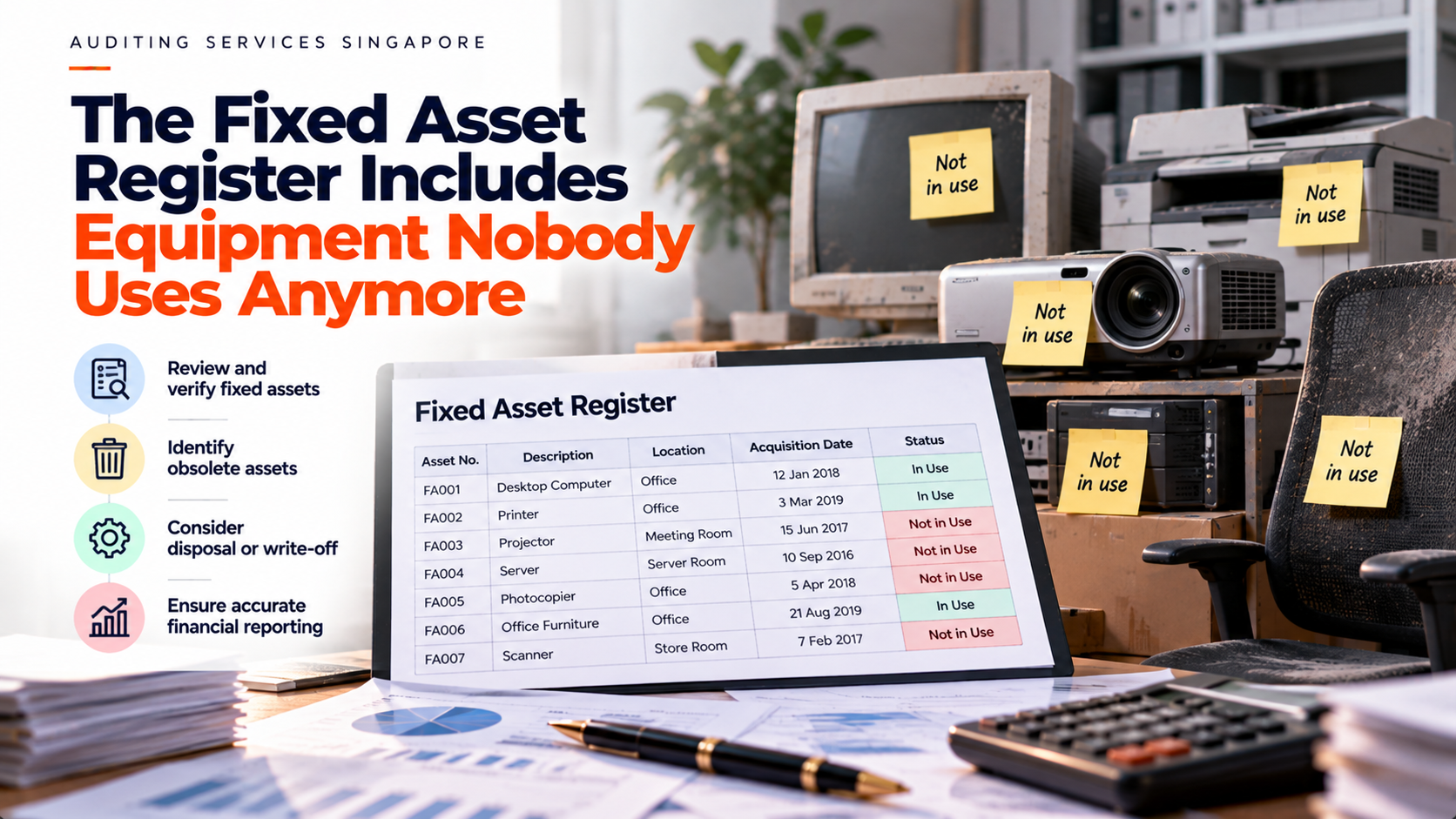
The fixed asset register appears orderly. Every item has a purchase date, an original cost and a depreciation calculation. Yet when finance asks where some of the equipment is located, the answers become less certain. One machine has been in storage since a production line closed. Several computers were replaced months ago. A department manager believes another item was collected by a recycling contractor.
The register may still agree with the general ledger, but that agreement does not establish whether the assets remain in use, exist at the recorded location or support the amounts shown in the accounts. The spreadsheet has continued moving forward while the business has changed around it.
Credon PAC provides accounting, bookkeeping and financial reporting services. For businesses reviewing their asset records, reliable reporting depends on connecting those records with operational information. The first step is to establish what happened to the equipment before deciding what should change in the accounts.
Start With the Equipment’s Actual Status
“Not in use” can describe several different situations. An asset might be held as a working backup, awaiting repair, reserved for a future project or permanently withdrawn from operations. It might also have been sold, scrapped or transferred without finance receiving the paperwork.
These situations should not receive the same response. Ask the responsible department to confirm the asset’s location, condition, ownership and intended use. Where possible, support the explanation with an inspection, photographs, maintenance records or transfer documents.
An unused machine with a credible operational role is different from one that cannot function and has no realistic future use. Equally, an asset that cannot be located should not automatically be treated as worthless without investigating whether it was moved or disposed of.
Record the findings against the asset identifier. This creates a clear basis for the accounting review and prevents a vague status description from becoming a permanent explanation.
Check the Register Against the Physical Equipment
A physical review should work in both directions. Starting with the register helps identify recorded assets that cannot be found. Starting with equipment on site helps identify items that are missing from the records or described incorrectly.
Use serial numbers, asset tags and specific descriptions where available. Labels such as “office equipment” or “production machine” can make it difficult to distinguish one item from another, especially after several years of purchases and replacements.
The review should also identify equipment held away from the main premises. Items may be at employees’ homes, with repair contractors or at another branch. Their location does not automatically indicate a problem, but it should be supported by a responsible person and a traceable record.
Where equipment belongs to a customer, a lessor or another group entity, clarify that position. Physical possession alone does not establish that the item belongs in the company’s own fixed asset register.
Separate Temporary Inactivity From Permanent Withdrawal
Temporary inactivity may have a reasonable explanation. A seasonal business could retain equipment for its next busy period, while a manufacturer may keep a backup machine to reduce disruption if its main equipment fails.
Management should be able to explain that purpose in practical terms. When was the backup last tested? Is it compatible with current operations? What event would cause it to return to service? Does the business have the staff and parts needed to operate it?
A statement that equipment “might be useful one day” is less persuasive when the business has changed its products, closed the relevant location or adopted a different production process.
Set a review date where the future use remains uncertain. An asset awaiting a decision should not remain indefinitely in the same category simply because nobody has taken responsibility for the next step.
Understand Why Depreciation May Continue
Stopping an asset’s use does not ordinarily stop depreciation under IAS 16. Depreciation generally continues while equipment is idle, subject to the applicable requirements. Under a usage-based method, the charge can be zero when there is no production, but that follows the method rather than a blanket exemption for unused equipment.
Management should also review whether the useful life, residual value and depreciation method remain appropriate. Changes in the expected use of equipment can affect those estimates.
A machine originally expected to support ten years of production may now be scheduled for earlier replacement. Continuing the original calculation without considering that change can leave the records out of step with the current plan.
Finance needs operational information to make this assessment. A depreciation schedule can calculate accurately while relying on assumptions that are no longer supported.
Consider Whether the Carrying Amount Is Recoverable
Unused or obsolete equipment may indicate that an impairment review is needed. The assessment is not simply whether the item remains physically present. It concerns whether the amount recorded can be supported through its use or disposal.
Under IAS 36, recoverable amount is the higher of value in use and fair value less costs of disposal. Where an asset does not generate largely independent cash inflows, the assessment may need to be performed at the appropriate cash-generating unit level.
This means an idle asset should not automatically be written down to an informal resale estimate. Management first needs to establish the appropriate basis and scope of the assessment.
Supporting information may include the operational plan, condition reports, relevant market evidence and forecasts where applicable. The review should explain the conclusion rather than preserve the existing amount merely because recognising a loss would reduce profit.
Use a Worked Example to Understand the Difference
Consider a hypothetical machine with an original cost of S$80,000 and accumulated depreciation of S$50,000. Its carrying amount is S$30,000. The company no longer uses it following a change in production.
Assume that an appropriately prepared assessment establishes a recoverable amount of S$12,000. On those assumptions, an impairment loss of S$18,000 would reduce the carrying amount to S$12,000. The original purchase cost does not demonstrate that the remaining S$30,000 is still recoverable.
The conclusion would depend on the actual circumstances and supporting evidence. A machine that remains valuable within an operating production unit may require a different assessment from a standalone item with no further operational role.
The example illustrates why three figures need to be distinguished: what the company originally paid, the amount currently recorded and the amount supported by the relevant assessment. They need not be the same.
Investigate Equipment That Has Already Left the Business
Sometimes the issue is not unused equipment but a disposal that finance never recorded. A department may have sold an old item, arranged collection by a recycler or exchanged it as part of a replacement purchase.
Obtain the relevant documents and establish the date and terms of the transaction. Review any proceeds, collection records and approval evidence. Where the documentation is incomplete, investigate rather than selecting a convenient date to clear the register.
IAS 16 requires derecognition on disposal or when no future economic benefits are expected from use or disposal. The accounting review should therefore address the facts and timing, including any necessary correction to the records.
Do not simply delete the register entry. Preserve the asset’s history and the supporting disposal record so that the movement in cost, accumulated depreciation and any resulting gain or loss can be followed.
Keep Fully Depreciated Assets Visible While They Remain Relevant
An asset with a zero carrying amount may still be in use. Removing it from the operational records solely because depreciation is complete can weaken control over equipment that continues to support the business.
The company should still know where the item is, who is responsible for it and when it is eventually disposed of. Fully depreciated computers, tools and machinery can have operational importance even when they no longer contribute a net amount to the balance sheet.
Conversely, a zero carrying amount does not make an unexplained disposal acceptable. The company may still need to investigate missing equipment, document its removal and account for any proceeds.
The register serves both reporting and control purposes. Maintaining clear status information helps fulfil those purposes without confusing the absence of a carrying amount with the absence of a physical asset.
Review Replacement Purchases Alongside Old Equipment
A new purchase can be a useful trigger for reviewing the equipment it replaces. Without that connection, finance may add the replacement while the old asset remains unchanged in the register.
The purchasing process should identify whether the new item replaces existing equipment, adds capacity or supports a different activity. Where a replacement occurs, record the old asset reference and the proposed action.
The old equipment may remain as a backup, move to another department or be disposed of. Each outcome needs confirmation. A purchase approval should not be treated as evidence that disposal has already occurred.
Credon’s bookkeeping and financial reporting services can support the recording and reconciliation of asset movements. Operational teams still need to communicate what happened to the replaced equipment so that the records reflect the business’s actual position.
Separate the Accounting Review From the Disposal Decision
Recognising an impairment does not physically remove equipment from the premises. Similarly, deciding to sell an item does not mean a sale has already taken place or that every accounting classification requirement has been met.
Management should assign responsibility for both the financial assessment and the operational decision. An item awaiting repair, sale or recycling needs an owner, a proposed action and a realistic timetable.
Consider the ongoing costs of keeping it. Storage, maintenance and insurance may continue even when the asset provides little practical benefit. Those costs can inform the business decision without replacing the required accounting assessment.
This distinction keeps the process moving. Finance can complete the necessary reporting work while operations progresses the approved action, with each team updating the other as circumstances change.
Maintain a Reconciliation and an Exception Log
The fixed asset register should reconcile with the relevant general ledger accounts. Explain opening balances, additions, transfers, depreciation, impairment and disposals so that the closing figures can be traced.
Alongside that reconciliation, maintain an exception log for unresolved operational matters. Examples include items awaiting inspection, assets whose location is uncertain and proposed disposals without completed documentation.
Each exception should identify the responsible person and the next action. A list that simply carries forward “under review” provides little evidence of progress.
Prioritise items according to their value, risk and operational significance. A missing high-value machine may need immediate attention, while a group of low-value items can be addressed through an organised review. The approach should be proportionate without allowing old differences to disappear from view.
Use Business Changes to Trigger Reviews
An annual exercise alone may not identify changes promptly enough. Branch closures, office moves, production changes and major replacement programmes are useful triggers for reviewing the affected assets.
Include finance in the handover for those events. A closure plan should address equipment retained, transferred, sold or discarded, together with the documents needed to update the records.
Department managers can also confirm asset status periodically, supported by targeted physical checks. The process should ask about changes since the previous review rather than merely requesting a signature against an unchanged list.
Over time, these checkpoints reduce the need for a large year-end investigation. They also make budgeting more useful because management can distinguish serviceable equipment from items that are recorded but no longer support operations.
Build an Asset Register That Reflects the Business
A fixed asset register is reliable when its figures and descriptions connect with equipment the company can identify and explain. Accurate depreciation formulas are only one part of that reliability.
The review should establish what exists, where it is, how it is used and what management intends to do next. Accounting conclusions should then follow the applicable requirements and supporting evidence, with unresolved matters clearly assigned.
Credon PAC provides accounting, bookkeeping and financial reporting support for businesses reviewing the quality of their records. Companies with unexplained or outdated asset entries can discuss how to organise the reconciliation and supporting information.
A practical starting point is the list of equipment marked unused, replaced or awaiting disposal. Confirm its status, document the next action and review the financial treatment. That creates a clearer connection between the assets shown in the accounts and the resources available to the business.