
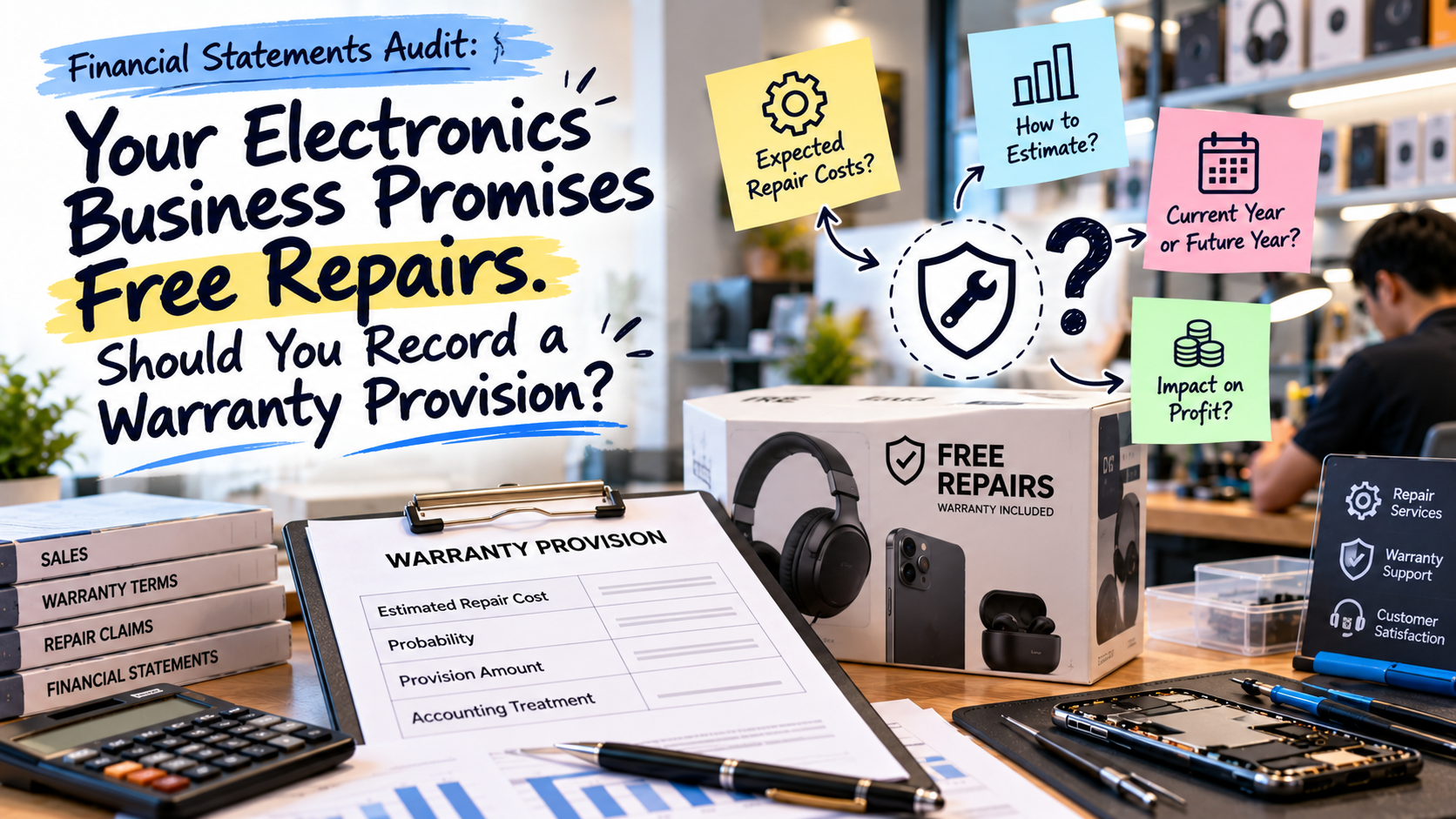
Your electronics business sells a product with a promise to repair manufacturing defects at no additional charge during the warranty period. Most customers never need that service, but some return with faulty screens, charging problems, or components that stop working.
The sales have already been recorded, while many repairs will happen in a later financial period. If the accounts include only repair costs already paid, do they reflect the obligations created by those sales?
This question can become important during a financial statements audit. A warranty promise may require an estimated liability before customers submit their claims. The answer depends on what your business has promised, who is responsible for fulfilling it, and the accounting framework that applies.
Start With the Promise Your Business Makes
Review the warranty terms customers receive when buying the product. Consider the sales agreement, product listing, receipt, warranty card, and any relevant statements made by your business.
Identify what is covered, how long coverage lasts, and what the customer must do to claim. Establish whether the remedy involves repair, replacement, or another response, and whether different products carry different terms.
For example, a retailer might advertise a standard manufacturer’s warranty while also promising its own additional repair support. Finance needs to understand both arrangements. Looking only at the manufacturer’s document could overlook a commitment the retailer has made directly to customers.
Establish Who Is Responsible for the Repairs
A retailer, distributor, manufacturer, and service centre can each have a role in handling a warranty claim. The party receiving the faulty product is not necessarily the party that bears every related obligation or cost.
Review the customer-facing promise alongside supplier and repair-provider agreements. Determine whether your company is responsible for providing the remedy, arranging access to another party’s warranty, or delivering additional services of its own.
Suppose your store accepts returned goods and sends them to a manufacturer. That process does not, by itself, establish that your company has no obligation. Equally, it does not automatically mean you should recognise the manufacturer’s entire expected repair cost. The accounting assessment needs to reflect the actual arrangement.
Distinguish Product Assurance From Additional Service Cover
An assurance warranty generally supports the promise that the product meets agreed specifications. A warranty that provides an additional service may require different accounting.
Under IFRS 15 and the corresponding full Singapore standards, a warranty that customers can purchase separately is treated as a distinct service. Where it cannot be purchased separately, the business still considers whether it provides additional service beyond product assurance.
This distinction matters for extended coverage, maintenance packages, and other bundled support. An assurance obligation is generally assessed under the provisions standard, while a service-type warranty involves allocating revenue to the service and recognising it as the obligation is fulfilled.
Do not classify every package using its marketing name. A “free extended warranty” may still contain a service component. Confirm the applicable reporting framework and assess the substance of the promise with your accountant.
Understand When a Provision Is Required
Under IAS 37 and the corresponding full Singapore requirements, a provision is recognised when a past event creates a present legal or constructive obligation, an outflow of resources is probable, and the amount can be estimated reliably.
For an assurance warranty, the relevant past event can be the sale carrying the warranty promise. The company does not necessarily wait for a particular customer to report a defect before recognising the expected obligation.
Where many similar warranties exist, the assessment considers the obligations as a group. A low likelihood of a claim on any single unit does not establish that no provision is needed across thousands of covered products. The estimate should reflect the expected cost of settling the existing obligation.
Separate Existing Warranty Exposure From Future Sales
A warranty provision should relate to obligations arising from products already sold at the reporting date. It is not a general reserve for repair work expected from next year’s sales.
Prepare a schedule of relevant sales by product group and period. Identify the coverage remaining and any claims already reported but not completed. Products sold near year-end may have substantially more remaining coverage than products sold early in the year.
Be careful not to count the same exposure twice. If a specific unresolved claim is included separately, ensure the broader estimate is adjusted appropriately. The calculation should explain how known claims and claims not yet reported fit together.
Use a Simple Example to Understand the Estimate
Imagine an electronics distributor has 10,000 units with remaining assurance-warranty exposure at year-end. Assume management’s supported estimate is that 3% will require one minor repair costing S$40 and 1% will require one major repair or replacement costing S$180.
If these outcomes are mutually exclusive and represent expected future costs for the remaining coverage, the illustrative calculation is:
Minor repairs: 10,000 × 3% × S$40 = S$12,000
Major repairs or replacements: 10,000 × 1% × S$180 = S$18,000
Total estimated future settlement cost: S$30,000
These figures are hypothetical, not industry benchmarks. The example assumes that the amounts include the relevant settlement costs, there are no separately counted unresolved claims, and discounting is immaterial.
A real estimate needs to reflect the company’s products, claims experience, coverage, and current information. Some products may experience repeat faults or several repair types, requiring a more detailed approach than this illustration.
Build the Estimate From Useful Claims Records
Historical repair information is valuable only if it can be connected to the products and warranty obligations being assessed. A total annual repair expense may combine several product generations, paid repairs, goodwill work, and warranty claims.
Record the product model, sale date, claim date, fault, remedy, and associated cost where practical. Identify whether the customer’s claim was accepted and whether the work related to the company’s own obligation.
A device returned twice should also be visible in the data. If the system counts every repair job as a separate affected unit, the calculated failure rate may be misleading. Finance and the service team should agree on what each measure represents before using it in the provision.
Compare Product Groups That Have Similar Characteristics
One provision percentage across the entire catalogue may hide meaningful differences. A simple accessory, a premium monitor, and a battery-powered device can have different failure patterns, repair costs, and warranty terms.
Group products in a way that reflects those differences without making the calculation unnecessarily complex. Consider whether model, supplier, product type, age, or another factor provides a useful basis.
For example, a newly introduced model may have limited company-specific history. Management could consider relevant information from comparable products and suppliers, while explaining the uncertainty and any differences. A lack of past claims is not automatically evidence that future warranty costs will be zero.
Update the Estimate for Current Information
Historical averages should be reviewed against what management knows now. A component problem, supplier change, rising parts prices, or recurring customer complaint may affect expected future settlement costs.
Suppose the service team identifies a charging fault affecting a particular production batch. Applying the ordinary portfolio rate without considering that information could understate the obligation.
Equally, a genuine improvement in product quality may support a different estimate if the evidence is sufficiently developed. Document the reason for changes rather than adjusting the percentage merely because management wants a particular profit result. Subsequent repair information can help assess conditions existing at year-end, but its timing and relevance need consideration.
Include the Costs Needed to Fulfil the Promise
A replacement component may be only one part of the cost. Depending on the obligation, settlement could involve technician work, third-party repair charges, collection, delivery, testing, or replacement units.
Identify which costs are relevant to fulfilling the warranty and use a consistent calculation. Explain how internally performed repairs are costed and avoid including the same labour or handling amount in more than one category.
For example, an external service provider’s fixed repair charge might already include testing and return delivery. Adding those costs separately would overstate the estimate. Conversely, using the spare-part price alone could omit expenditure the business must incur to complete the repair.
Assess Supplier Recovery Separately
Your supplier may agree to reimburse repair costs or replace faulty units. That arrangement can reduce the economic burden, but it does not automatically remove your obligation to the customer.
Where the company remains responsible, IAS 37 generally requires the liability to be assessed in full. A reimbursement asset is recognised separately only when receipt is virtually certain if the company settles the obligation, and it cannot exceed the provision.
Review the recovery terms, exclusions, claim procedures, and evidence of settlement. A supplier’s general statement that it “stands behind its products” may not establish recovery of every cost your company incurs.
For example, the supplier might provide replacement parts while your business bears labour and transport. Netting the entire expected repair cost against an assumed supplier recovery would overlook those differences.
Keep Discretionary Goodwill Repairs Visible
Businesses sometimes repair products outside the written warranty to preserve customer relationships. Track these cases separately so that the ordinary warranty calculation is not based on an unexplained mixture of obligations and discretionary decisions.
However, written terms are not always the whole assessment. A consistent established practice or sufficiently specific communication may create expectations that need to be considered when assessing a constructive obligation.
Document who approves goodwill work and why. If the business routinely extends coverage, discuss whether the accounting assessment and customer-facing policy accurately reflect what the company actually does. Avoid assuming either that all goodwill repairs create a provision or that none can affect the obligation.
Reconcile the Provision as Claims Are Settled
Maintain a movement schedule showing the opening provision, amounts used for relevant claims, changes in estimates, and closing balance. This helps management understand why the liability has changed.
When qualifying repairs occur, the accounting should reflect their settlement against the relevant provision without also counting the same cost twice as a new expense. Your accountant should establish entries appropriate to the repair process and records.
Review unused balances as coverage expires or expectations change. A provision should not remain untouched simply because it was accepted in a previous year. Nor should it be released without checking unresolved claims and the remaining obligation.
Prepare Evidence for the Financial Statements Audit
The audit team may ask for warranty terms, sales data, claims history, repair costs, supplier agreements, and management’s calculation. Significant assumptions and changes from the prior year need clear explanations.
Prepare an assessment that connects the evidence to the estimate. Explain the product groupings, remaining coverage, claim rates, cost assumptions, known issues, and treatment of recoveries.
Management is responsible for the estimate and financial statements. The auditor independently evaluates whether sufficient appropriate evidence supports the amounts and disclosures. A well-organised calculation makes that review more useful than presenting a percentage of sales with no explanation of its basis.
Use the Review to Understand Product Performance
Warranty information can also improve management’s understanding of product profitability. A product with an attractive initial margin may generate substantial after-sales costs that become visible only months later.
Compare product sales with the related repair experience, while distinguishing provision estimates from actual settlement costs. This can help management investigate supplier quality, assess pricing, and review whether customer promises remain commercially sustainable.
Avoid making purchasing decisions from claim counts alone. A high-selling product may produce more claims simply because more units are in circulation. Consider rates, severity, repair cost, and remaining exposure together before drawing conclusions.
Discuss Warranty Accounting With Credon
Credon PAC provides audit and assurance services alongside financial reporting and other professional support. For an electronics business, explaining its warranty arrangements is an important part of helping the audit team understand the financial statements.
Bring customer terms, supplier agreements, product sales records, and service-centre information into the discussion. Identify where the business lacks reliable data and where different teams have different understandings of who bears the cost.
A financial statements audit considers obligations that may exist before the next repair invoice arrives. A free-repair promise can carry a measurable future cost, even when most products work as expected. Understanding the promise, estimating the remaining obligation, and maintaining clear records gives management a stronger basis for both reporting and commercial decisions.