
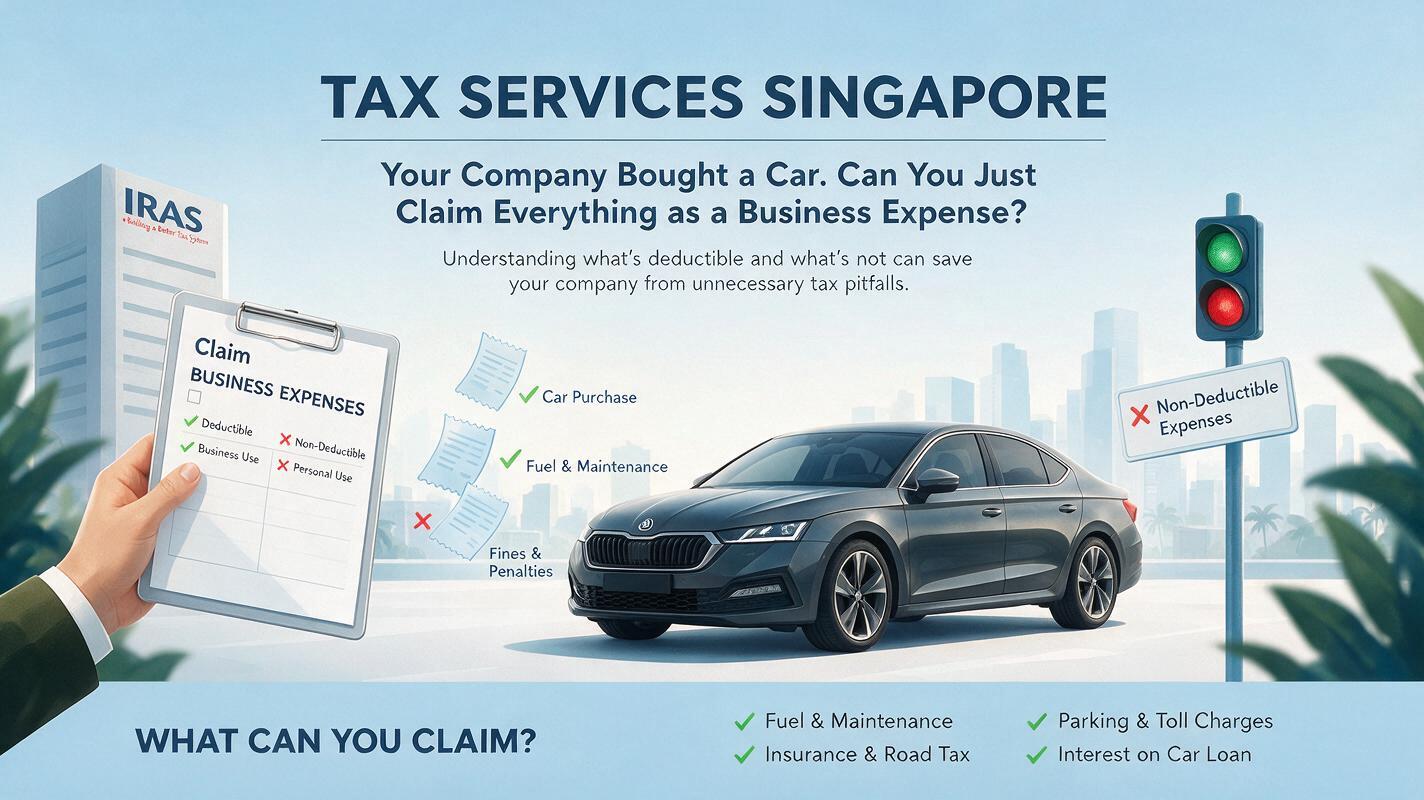
The Company Paid for the Car, So It Must Be a Business Expense, Right?
Your company has been doing well, and management decides that it is finally time to purchase a car. Perhaps the managing director regularly travels to customer meetings, the sales team needs transportation or the owner simply believes that having a company vehicle will make business travel more convenient. The company pays for the vehicle, the registration is connected to the business arrangement and expenses such as petrol, parking, insurance, servicing and repairs are paid from the corporate bank account. From a business owner’s perspective, the conclusion can seem obvious. The company paid for the car and employees use it for work, so all the costs should be deductible business expenses. In Singapore, however, the tax treatment is not that simple. The fact that a company pays an expense does not automatically make it tax-deductible, and motor cars are a particularly important example because specific restrictions apply to certain vehicles. For companies seeking professional tax services Singapore, understanding the distinction between accounting for a vehicle and claiming tax deductions for it can prevent an unpleasant surprise when the corporate tax computation is prepared.
Paying Through the Company Does Not Decide the Tax Treatment
One of the most common misunderstandings about corporate expenses is that anything paid using the company’s bank account automatically reduces taxable income. Tax rules do not work that way. In general, business expenses need to satisfy the relevant conditions for deductibility, including being incurred in the production of income, being revenue rather than capital in nature, and not being specifically prohibited from deduction under the Income Tax Act. This means the accounting records and the tax computation can legitimately treat the same transaction differently. Your accountant may record an expense because the company genuinely incurred it, while the tax computation later adds that amount back because it is not deductible for corporate income tax purposes. Motor vehicle expenses demonstrate this difference particularly clearly.
The Type of Vehicle Makes a Huge Difference
When discussing vehicle expenses, it is important not to treat every vehicle as though it were the same. IRAS distinguishes between private cars and goods or commercial vehicles for tax purposes. Motor vehicle expenses incurred on goods and commercial vehicles such as vans, lorries and buses can generally be tax-deductible, while expenses relating to private cars such as S-plated cars, as well as certain business cars such as Q-plated and RU-plated cars, are specifically restricted. This distinction can surprise owners because they may focus primarily on whether the vehicle is genuinely being used for business. The tax rules, however, also care about what kind of vehicle is involved.
An S-Plated Car Used for Business Does Not Automatically Become Tax-Deductible
Imagine your company purchases an S-plated passenger car and the managing director uses it almost entirely for work. Monday involves visiting a customer in Jurong. Tuesday involves a meeting in Changi. Wednesday involves travelling to a supplier. Thursday involves attending a business event, and Friday involves another customer presentation. Management may argue that 80 or 90 per cent of the vehicle’s use is business-related, so surely the company should be able to deduct most of the running costs. This is where Singapore’s rules can catch businesses by surprise. IRAS states that motor vehicle expenses incurred on private cars such as S-plated cars are non-deductible, even when the cars are used for business purposes. In other words, proving that the director drove to a customer meeting does not by itself turn the relevant private-car expenses into deductible corporate expenses.
Petrol Is an Obvious Cost, but That Does Not Make It Deductible
Petrol is often the first expense business owners think about because it is directly connected to driving. The company car needs fuel to reach customers, suppliers and meetings, so commercially it feels like a straightforward operating cost. Nevertheless, where the expense relates to a private car covered by the restriction, IRAS identifies petrol among the motor vehicle costs that are not tax-deductible. The key lesson is that economic logic and tax deductibility are not always identical. An expense can be genuinely incurred by the company, genuinely connected with business travel and still be disallowed for income tax purposes because a specific tax rule applies.
Parking, Repairs and Maintenance Can Face the Same Problem
The same misunderstanding often appears with other running costs. Perhaps the company pays S$2,000 for servicing and repairs, another amount for parking and further expenses for maintaining the vehicle. Management may assume that even if purchasing the car receives special treatment, surely these ordinary running expenses can be deducted. For affected private cars, that assumption can be incorrect. IRAS specifically lists items such as repairs, maintenance, parking and petrol when explaining the restriction on private-car motor vehicle expenses. The fact that the company has an invoice and can prove payment does not override the specific restriction.
Reimbursing the Employee Does Not Necessarily Solve the Problem
A company might think there is an easy alternative. Instead of purchasing the car itself, perhaps the director or employee owns an S-plated car personally and the company reimburses the petrol, maintenance or other costs incurred during business travel. Economically, management may see this as completely different because the company does not own the vehicle. However, IRAS states that no deduction is allowed on relevant motor vehicle expenses for private cars whether the expenses are incurred directly or paid through reimbursement. Simply changing who initially pays the bill does not necessarily change the nature of the underlying expense.
A Transport Allowance Is Not the Same as Reimbursing Private-Car Expenses
This is where terminology becomes important. IRAS distinguishes reimbursement of private-car expenses from a transport allowance paid to staff. Its published guidance indicates that a transport allowance to staff can be deductible to the company, although the allowance is taxable as part of the employee’s employment income. This is a good example of why businesses should avoid assuming that two arrangements producing a similar commercial outcome automatically receive identical tax treatment. The structure and nature of the payment matter, and employee tax consequences may also need to be considered.
What About Taking a Taxi or Other Transportation Service to the Meeting?
Here the outcome can be different again. IRAS distinguishes payments for transportation services from the expenses of operating or hiring a private car. A transportation service involves paying for transportation from one place to another without having control or possession of the motor car, and payments for transportation services for business purposes can qualify for tax deduction. This means “transport expense” is not one universal tax category. A taxi journey for a legitimate business purpose and petrol for an S-plated company car may both feel like costs of travelling to a customer, but they can receive different tax treatment.
The Purchase Price Creates Another Misunderstanding
Suppose the company purchases a passenger car for S$180,000. Management may initially think the S$180,000 should reduce taxable profit because the company spent the money during the year. However, purchasing a long-term asset is generally capital expenditure rather than an ordinary revenue expense. For qualifying fixed assets, tax relief may instead be available through capital allowances because accounting depreciation itself is generally not tax-deductible. But this leads to the next important issue: not every asset qualifies for capital allowances, and private passenger cars are specifically restricted.
You Cannot Simply Use Depreciation to Obtain the Tax Deduction
In the financial statements, the company may recognise depreciation on a vehicle over its expected useful life. Business owners sometimes assume that if the accounting system records S$30,000 of annual depreciation, the same S$30,000 will automatically reduce taxable income. IRAS states that depreciation accounted for in financial statements is not tax-deductible. For qualifying assets, companies may instead claim capital allowances. The distinction between accounting depreciation and tax capital allowances is fundamental because it explains why taxable income can differ from the profit shown in the financial statements.
Private Passenger Cars Face a Further Restriction on Capital Allowances
Normally, capital allowances provide tax deductions for the wear and tear of qualifying fixed assets used in the trade or business. However, IRAS specifically states that capital allowances cannot be claimed on the costs of private cars such as S-plated cars and certain business cars, subject to limited exceptions such as qualifying cars registered and used for private-hire or driving-instruction businesses. This means a company cannot simply say, “Fine, if the purchase price is capital expenditure, we will claim capital allowances instead,” where the vehicle itself falls within the prohibited category.
The COE Does Not Create a Separate Escape Route
Singapore’s vehicle costs make the Certificate of Entitlement particularly significant, so an owner may wonder whether the COE can be separated from the car for tax purposes. IRAS treats expenditure incurred to obtain a COE to acquire a motor vehicle as part of the cost of the vehicle. Where the vehicle itself qualifies for capital allowances, the COE cost may be included in the qualifying cost. But if the underlying private passenger car does not qualify for capital allowances, separating the COE conceptually from the vehicle does not suddenly create a deduction. This is another reason companies should consider tax treatment before assuming that every component of a vehicle purchase will provide tax relief.
A Van Can Be a Completely Different Tax Story
Now change the example. Instead of purchasing an S-plated passenger car for the managing director, imagine a company acquires a van that is genuinely used in its business to transport goods or equipment. IRAS identifies goods and commercial vehicles such as pick-ups, vans, trucks, lorries and buses as examples of motor vehicles that may qualify for capital allowances when acquired for business use. Motor vehicle running expenses for goods and commercial vehicles, including relevant maintenance and operating costs, are also generally deductible. The word “vehicle” therefore tells you very little by itself. The classification and use of the vehicle are critical.
A Lorry Used for Deliveries Is Not Treated Like the Director’s Sedan
Consider two companies that each spend S$100,000 on vehicles. Company A purchases a passenger car for its director. Company B purchases commercial vehicles used to deliver goods to customers. From the bank’s perspective, both companies spent S$100,000. From an accounting perspective, both may recognise vehicle assets. But the corporate tax treatment can differ significantly because the tax rules distinguish between private passenger cars and qualifying goods or commercial vehicles. This is exactly why business owners should be cautious about making tax assumptions based solely on how much was spent or whether the vehicle appears in the company’s fixed asset register.
A Motorcycle Can Also Be Different From a Private Passenger Car
IRAS includes motorcycles among examples of motor vehicles that may qualify for capital allowances when acquired for business use. For a company that genuinely requires motorcycles for operational purposes, this distinction can be relevant. Again, the important lesson is not to apply one blanket rule to everything with wheels. Passenger cars, commercial vehicles, motorcycles and other arrangements can have different tax consequences.
What if the Company Rents a Private Car Instead of Buying One?
Businesses may assume renting avoids the restriction because the company does not own the vehicle. However, IRAS distinguishes between paying for transportation services and hiring a private car. Its guidance states that expenses incurred on hiring a private car and the operation or maintenance of a hired private car are generally not tax-deductible unless the company is carrying on the business of hiring out cars or providing driving instruction. Therefore, changing from ownership to rental does not automatically produce the tax result management expects.
Business Purpose Alone Is Not Always Enough
This is perhaps the most important lesson from the car example. Usually, when business owners think about deductibility, they ask a logical question: “Was this expense incurred for the business?” That is an important question, but it is not always the only question. IRAS’s general corporate expense conditions also require that expenses are not specifically prohibited from deduction under the Income Tax Act. Private-car expenses demonstrate why that final condition matters. A cost can have a clear commercial purpose but still be restricted by a specific tax rule.
The Accounting Expense Can Still Exist Even When the Tax Deduction Does Not
This is where business owners sometimes become suspicious of the accounts. They see petrol, insurance or depreciation in the company’s profit and loss statement and later see tax adjustments relating to certain vehicle costs. It may appear that the accountant is contradicting themselves. In reality, financial accounting and tax computation serve different purposes. The accounts record the company’s financial transactions according to the relevant accounting requirements, while the tax computation adjusts accounting profit to arrive at taxable income under tax rules. IRAS’s own ECI example illustrates this principle by starting with accounting net profit and adding back items such as depreciation and transport expenses relating to an S-plated car before considering applicable capital allowances on qualifying assets.
This Is Why Taxable Profit Can Be Higher Than Accounting Profit
Imagine the company’s financial statements report S$500,000 of profit after recording S$15,000 of relevant private-car expenses and S$30,000 of depreciation. Management may assume tax is calculated directly from the S$500,000 figure. However, tax computations can require non-deductible items to be added back. The final taxable amount can therefore differ from accounting profit. The exact result depends on all relevant facts and adjustments, but the concept is important: recording an expense in the accounts does not guarantee that the same expense reduces taxable income.
Buying the Car in December Does Not Create a Magic Year-End Tax Deduction
Some business owners naturally think about purchasing equipment or vehicles before the financial year-end because they expect spending money to reduce profit and therefore reduce tax. That reasoning can be dangerous if applied without understanding the rules. Purchasing a fixed asset is not necessarily an ordinary deductible expense, and private passenger cars face specific restrictions on capital allowances. Spending S$200,000 on an S-plated car in December therefore should not be treated as a simple strategy for reducing corporate taxable income. Tax decisions should follow the applicable rules rather than the assumption that “more spending equals less tax.”
An Expensive Car Does Not Automatically Create a Bigger Tax Benefit
The same principle applies when choosing between vehicles. A business owner may reason that buying a S$300,000 car instead of a S$150,000 car will create a larger business expense and therefore a larger tax deduction. If the relevant expenditure is prohibited from deduction, spending more does not solve the problem. The company has simply committed more cash to an asset without obtaining the tax deduction management expected. Commercial decisions about vehicles should therefore be made primarily based on the company’s operational needs, affordability and broader circumstances, with tax treatment properly understood rather than assumed.
Putting the Company’s Name on the Invoice Is Not Enough
Another common misconception is that documentation determines everything. Proper invoices and records are certainly important, but having “ABC Pte. Ltd.” printed on the vehicle invoice does not automatically make every related cost deductible. The nature of the vehicle and expense still matters. Documentation proves what happened. It does not transform a specifically disallowed expense into an allowable one. Good tax compliance therefore requires both proper evidence and correct classification.
The Company’s Bank Account Is Not a Tax-Deductibility Machine
This principle extends far beyond cars. A company can pay for something without receiving a corporate income tax deduction for it. Certain capital expenditures, private expenses, statutory fines and other disallowed items may appear in the company’s accounting records but require tax adjustments. The car example is useful because it makes the distinction easy to understand. “The company paid” answers the question of who settled the bill. It does not by itself answer the question of whether the expense is deductible.
What About a Car Provided to an Employee?
When a company provides a car or car-related benefits to an employee, another layer of tax considerations can arise because the employee may receive a taxable benefit. IRAS publishes specific rules for determining the taxable value of employer-provided car benefits and the treatment of various car-related allowances and reimbursements. This means management should avoid looking only at the company’s corporate tax deduction. Depending on the arrangement, there may also be employment-income reporting considerations for the employee receiving the benefit.
A Benefit Can Have Different Consequences for the Company and Employee
This is an important broader tax principle. The tax treatment for the employer and employee does not always mirror each other. Something being taxable to an employee does not automatically mean the employer receives a deduction in every circumstance, and something being non-taxable to an employee does not automatically determine the company’s corporate tax treatment. IRAS itself notes in its corporate business-expense guidance that staff welfare or benefits taxable in employees’ hands do not automatically qualify for deduction and vice versa. Businesses therefore need to consider each side of the arrangement rather than assuming one tax outcome determines the other.
Keep Proper Records Even When You Think the Treatment Is Obvious
Businesses should retain appropriate supporting documents for vehicle purchases and operating expenses. These may include invoices, agreements, payment records and information identifying the vehicle involved. Good records help the company’s accountant or tax adviser determine the correct treatment and support positions taken in the tax computation. They also make it easier to distinguish commercial-vehicle costs from restricted private-car expenses where a company operates several types of vehicles.
Mixing Several Vehicles Makes Accurate Classification More Important
Imagine a logistics company owns six vans, two lorries and one passenger car used by management. If every petrol, repair and parking expense is posted to one general ledger account called “motor vehicle expenses,” preparing the tax computation becomes unnecessarily difficult. Some of those expenses may relate to qualifying commercial vehicles while others relate to the private passenger car. The finance team may then need to reconstruct the details months later. Maintaining sufficient information by vehicle or category can make year-end tax work much more efficient.
Ask Before Buying, Not After Filing
One of the most valuable reasons to obtain professional tax advice is timing. The least useful moment to discover that a S$200,000 vehicle does not provide the tax deduction management expected is after the company has already purchased it. Before a significant transaction, management can ask what the accounting treatment is likely to be, whether the expenditure is deductible, whether capital allowances are available and whether employee benefit implications arise. The purpose is not to let tax considerations dictate every commercial decision. It is to ensure management understands the financial consequences before committing the money.
Tax Planning Is Not the Same as Buying Things to Reduce Tax
Business owners occasionally become overly focused on deductions near year-end. If the company expects a strong profit, there may be a temptation to purchase vehicles, equipment or other items primarily because “we need more expenses.” But spending S$100 to save a fraction of that amount in tax is not automatically a good business decision. Even where expenditure qualifies for tax relief, the company is still spending real money. And where the expenditure is specifically restricted, the expected tax benefit may not exist at all. Good tax planning is about making informed decisions within the rules, not creating unnecessary expenditure simply to chase deductions.
Commercial Need Should Still Come First
If the company genuinely needs a vehicle to operate efficiently, purchasing one may be a perfectly sensible business decision even if certain tax deductions are unavailable. A managing director may need reliable transportation, or a company may decide that providing a vehicle is appropriate for operational or employee-benefit reasons. The tax rules do not determine whether the purchase is commercially worthwhile. They determine the tax consequences. Management should therefore separate the two questions: “Should our business buy this vehicle?” and “What tax treatment applies if we do?” Both matter, but they are not the same question.
A Commercial Vehicle Should Also Be Genuinely Connected to the Business
The fact that commercial vehicles can receive different tax treatment does not mean businesses should simply choose a different vehicle classification and assume everything becomes deductible. General tax principles still matter, including whether expenditure is incurred for the production of income and whether relevant conditions are satisfied. Companies should select vehicles based on genuine operational requirements and maintain appropriate records supporting their business use.
Foreign-Registered Cars Can Have Different Rules Again
There are additional situations where the outcome differs. IRAS states that expenses relating to foreign-registered cars used exclusively outside Singapore for business purposes can be deductible, and qualifying capital expenditure on such vehicles may also receive capital allowances. This is another reminder that tax treatment depends heavily on the specific facts. A rule heard from another business owner may be correct for their vehicle and completely wrong for yours.
Special Businesses Can Also Have Different Treatment
Private-hire and driving-instruction businesses are examples where special circumstances matter. IRAS provides exceptions concerning cars registered as private-hire cars or cars for instructional purposes when they are hired out or used for driving instruction in the course of the company’s business. Therefore, a statement such as “Singapore companies can never claim anything relating to passenger cars” would also be too broad. Tax advice needs to reflect what the company actually does.
Your Friend’s Company May Not Be a Reliable Tax Guide
Business owners often learn tax rules from other business owners. Someone says, “My company claims vehicle expenses every year,” and it sounds like confirmation that you can do the same. But perhaps their company operates vans. Maybe they run a vehicle-related business. Perhaps the expense being discussed is a transport allowance rather than reimbursement of private-car costs. Or perhaps their treatment is simply incorrect. Tax decisions should be based on the applicable rules and your company’s facts rather than informal comparisons.
The Most Dangerous Tax Advice Often Sounds Completely Logical
“The company owns it, so claim it.” “It is used for work, so deduct it.” “There is an invoice, so it is allowed.” “My accountant put it under expenses, so it must reduce tax.” Each statement sounds reasonable, which is precisely why misconceptions can persist. Tax rules frequently contain distinctions that ordinary commercial logic does not reveal. Motor vehicles are a good example because the difference between a passenger car and commercial vehicle can fundamentally change the result.
Professional Tax Support Helps Translate the Rules Into Business Decisions
Most SME owners do not need to memorise every section of Singapore’s tax legislation. They do, however, need enough understanding to recognise when a transaction may have tax consequences worth checking. A professional adviser providing tax services Singapore can help businesses prepare tax computations, identify deductible and non-deductible expenses, consider capital allowance claims and address other corporate tax matters according to the company’s circumstances. Royal Premier PAC provides corporate tax and related professional services for Singapore businesses, giving companies a resource to consult when transactions become more complicated than simply recording an invoice in the accounting system.
The Better Question Is Not “Can the Company Pay for It?”
Before purchasing a vehicle, management should ask several different questions. What kind of vehicle is it? Why does the business need it? How will it be used? What is the accounting treatment? Are the running costs deductible? Does the vehicle qualify for capital allowances? Will an employee receive a taxable benefit? Are there alternative transportation arrangements with different commercial and tax consequences? These questions create a much more complete picture than simply asking whether the company can make the payment.
Conclusion: A Company Car Is a Perfect Example of Why Business Expense and Tax Deduction Are Not the Same Thing
Your company buys a car.
The company pays for the petrol.
The company pays for the servicing.
The company pays for the parking.
The company pays for the insurance.
The director drives it to customer meetings.
Everything looks like a business expense.
But that still does not automatically mean everything is tax-deductible.
Singapore’s corporate tax rules specifically restrict motor vehicle expenses relating to private cars such as S-plated cars, even when they are used for business purposes. Relevant reimbursements do not automatically escape the restriction either. Goods and commercial vehicles such as vans, lorries and buses can receive different treatment, and qualifying vehicles may also be eligible for capital allowances.
That distinction teaches a much larger lesson.
Accounting expenses and tax deductions are not identical.
Your accountant may correctly record an expense in the financial statements while correctly adding it back when preparing the tax computation.
The company may genuinely spend cash without obtaining a tax deduction.
A vehicle may genuinely be used for business while still falling within a specific restriction.
And two vehicles purchased by two Singapore companies can have very different tax consequences depending on what they are and how they are used.
This is why business owners should avoid using a simple rule such as:
“Company pay means company can claim.”
Instead, think:
What exactly did the company pay for, what tax rule applies to that expenditure and what documentation do we need?
For a S$50 expense, getting the classification wrong may not feel significant.
For a vehicle costing S$150,000, S$200,000 or more, misunderstanding the treatment can materially change management’s expectations.
So if your company is considering buying a car because someone told you:
“Buy under company lah, can claim tax.”
There is one very useful response:
“Claim what, exactly?”
Ask that question before signing the purchase agreement, not after the tax computation arrives.